A living room’s square footage says little about how well an air purifier will work there.
Is the “500 sq ft” sticker on the box helpful when the living room has cathedral ceilings, an open plan to the kitchen, or a wood-burning stove? Living rooms combine variable volumes and multiple pollutant sources — pets, cooking oils, smoke, and off-gassing furniture — so a simple coverage number is often misleading.
Picking the wrong capacity forces a trade-off: running a too-small unit at maximum speed to compensate creates noise and wear while still leaving pockets of polluted air; buying an oversized unit wastes upfront cost and energy. The decision should focus on actual room volume, pollutant types, and how many air changes per hour are needed, not just the advertised square-foot coverage.
Quick definitions
- CADR (Clean Air Delivery Rate)
A manufacturer-measured flow rate (cubic feet per minute, CFM) showing how much clean air a purifier delivers for specific particles (smoke, pollen, dust).
- ACH (Air Changes per Hour)
How many times the purifier will replace the air in a room in one hour; higher ACH means faster reduction of airborne particles.
- Room volume
The three-dimensional size of a space (floor area × ceiling height), expressed in cubic feet; it determines how much air must be moved to reach a target ACH.
- Square‑footage claims
Manufacturer statements based on floor area alone; they can be misleading because they ignore ceiling height and desired ACH.
Formula: CADR (CFM) = (Room volume in cubic feet × Desired ACH) ÷ 60
Steps:
Measure floor length × width × ceiling height to get volume (cu ft). Pick a target ACH (common living-room targets range from 3–6 ACH depending on needs). Apply the formula to get required CADR.Example: a 15×20 room with 8 ft ceilings is 2,400 cu ft. For 4 ACH: 2,400 × 4 ÷ 60 = 160 CFM required.
Why square‑foot claims mislead: area-only ratings ignore ceiling height and the chosen ACH, so two rooms with the same floor area can need very different CADR. Always calculate from volume and desired ACH for an accurate match.
Step-by-step sizing procedure
- Measure the living room
Record width, length and ceiling height in feet (or meters). Multiply to get room volume: cubic feet = width × length × height. If using meters, volume in m³ converts to ft³ by multiplying by 35.3147.
- Choose an ACH target
Decide how many air changes per hour (ACH) are appropriate for the room’s use and pollution level. Typical guidance: 3–5 ACH for routine odor and dust control, 5–8 ACH for higher removal needs; higher targets suit heavy smoke or frequent pollution events.
- Compute the required CADR
Convert the ACH target into a Clean Air Delivery Rate (CADR) in cubic feet per minute (CFM) using: CADR (CFM) = room volume (ft³) × ACH ÷ 60. As an alternative, CADR in m³/h = room volume (m³) × ACH.
- Worked example — small living room
Example: 12 ft × 14 ft × 8 ft → volume = 1,344 ft³. With 4 ACH: CADR = 1,344 × 4 ÷ 60 = 89.6 CFM ≈ 90 CFM. Select a purifier with a rated CADR of at least this value (allow a safety margin).
- Worked example — large open-plan space
Example: 25 ft × 20 ft × 9 ft → volume = 4,500 ft³. With 5 ACH: CADR = 4,500 × 5 ÷ 60 = 375 CFM. For very large or irregular layouts, consider multiple units or a higher CADR and add a 10–25% buffer.
- Choose and confirm
Pick an air purifier whose certified CADR meets or exceeds the calculated requirement for the relevant pollutant (smoke, dust, pollen). Verify placement for unobstructed airflow and re-run the calculation if room layout or use changes.
CADR ratings are pollutant-specific (smoke, pollen, dust). Use the CADR category matching the main indoor pollutant and add a modest buffer to account for furniture and real-world losses.
CADR (CFM) = room volume (ft³) × ACH ÷ 60
For metric: CADR (m³/h) = room volume (m³) × ACH Round up to the next common CADR rating and consider two smaller units for very large or zoned spaces Choose the CADR figure that matches the pollutant of concern (smoke/dust/pollen)ACH targets and common myths
Coverage often reflects floor area under ideal, single-pass conditions—not real-world ACH for specific pollutants.
Manufacturers may report area based on quiet fan settings or a single-pass CADR; actual removal depends on air exchanges per hour and pollutant type.
CADR measures removal rate for test particles in a lab; room layout, obstructions, and ACH determine actual results.
Two units with the same CADR can perform very differently once placed, obstructed, or run at different speeds.
Higher-rated models may require higher fan speeds, producing more noise; filter type and ACH target matter more.
Overpowered units can be noisy or cyclical if run at low speeds; pick a unit that reliably achieves the required ACH with a reasonable noise trade-off.
Always size for the most demanding scenario expected. Typical ACH targets:
2–4 ACH: routine dust, pet dander, light odors. 4–8 ACH: wildfire smoke, heavy indoor smoke, and higher airborne particulate loads. 8–12 ACH: severe smoke events or situations requiring rapid particle reduction.Choose the higher ACH when multiple risks exist; then calculate CADR from room volume and add a modest buffer for real-world losses.
Quick FAQs on Coverage Labels and CADR
What does a 'coverage' label actually mean?
Coverage usually refers to floor area under ideal conditions, not real-world pollutant removal rates. Labels often assume low ceiling height and a specific ACH.
How does CADR relate to the ACH calculation?
CADR is a measured clean-air flow (CFM) for specific particles; ACH is the number of air changes per hour. Use CADR to verify it meets the CFM required by the ACH calculation.
Are CADR numbers comparable across brands?
Only when measured to the same standard (e.g., AHAM). Different test methods or undisclosed conditions make comparisons unreliable.
Does a higher CADR always mean better performance?
Higher CADR yields faster removal for the tested particle size, but filter type, noise at that setting, and real-room airflow also matter.
Can one CADR number cover smoke, dust, and pollen equally?
CADR is usually reported separately for smoke, dust, and pollen; choose the CADR for the worst-case pollutant in the room.
Checklist to Vet Coverage and CADR Claims
- Match CADR to required CFMConfirm reported CADR (CFM) equals or exceeds the computed CFM plus a safety buffer.Look forCADR ≥ required CFM + 20%AvoidRelying only on floor-area claims
- Pollutant-specific CADRCheck smoke/dust/pollen CADR values and prioritize the highest-risk pollutant.Look forSeparate CADR numbers for common particlesAvoidSingle vague CADR or generic 'coverage'
- Third-party testingPrefer devices tested to recognized standards or AHAM verification.Look forAHAM or lab-test mentionAvoidUndocumented performance claims
- Real-world factorsConsider noise at the required setting, room layout, and ceiling height.Look forNoise specs at chosen fan speedAvoidAssuming ideal, open-room performance
Placement and multi‑unit strategies
Place purifiers where air actually circulates, not tucked behind furniture. Keep intakes and exhausts clear (at least 6–12 inches), avoid corners and tight alcoves, and position near steady pollutant sources (cooking area, fireplace) when present. For airborne particles, mount or raise a unit so its intake is closer to the breathing zone; for gases, a lower or central placement can improve mixing.
Practical tips
- Put units in the main activity zone or along the most direct airflow path (near doorways or open-plan seams).
- Leave room for 360° circulation; don’t block with curtains or sofas.
- Elevate smaller units on a table if sofas block floor flow.
One unit versus multiple
A single large purifier can work if its CADR covers the entire open volume and it sits centrally with unobstructed flow. Multiple smaller units outperform one large unit in very large, L‑shaped, or multi‑zone living rooms because they shorten clean times and reduce required fan speeds.
Noise and shared spaces
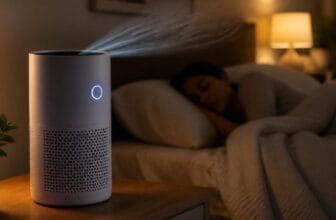
Balance CADR and sound level: place noisy units away from seating, run high speeds when rooms are unoccupied, and pick a quiet model for your living room or bedroom. Multiple units often allow lower fan settings and less perceptible noise while maintaining the same overall clean-air delivery.
Place one unit per contiguous zone—or place a single unit centrally if its CADR meets the combined zone volume. Multiple units reduce runtime and noise.
Filter types, replacement rhythm, HEPA grades, and loading effects
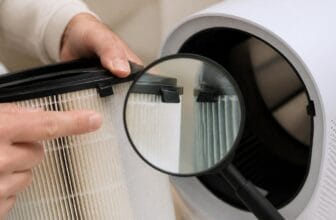
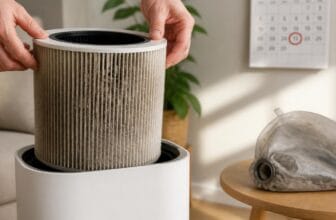
Set a rhythm: log run hours and inspect the prefilter monthly.**
Quick checklist:
Vacuum prefilter; check seals and gaskets. Note airflow or noise changes as indicators of loading.Why it matters: small, regular interventions keep real-world CADR much closer to the rated value and extend HEPA life.
Pre-purchase checklist
Final rule‑of‑thumb and closing
- Always size to the most demanding pollutant expected (e.g., smoke needs higher ACH than pollen).
- Prefer a model whose listed CADR is at least 1.5× the computed required CADR to allow for filter loading and placement loss.
Rule of thumb: choose a purifier with roughly 1.5× the calculated CADR for the room and pollutant of concern. Also verify real‑world noise at the operating speed, filter availability and ongoing costs before buying. For background on when a purifier is beneficial and how CADR/ACH work, consult the starter guide and the technical primer linked above.