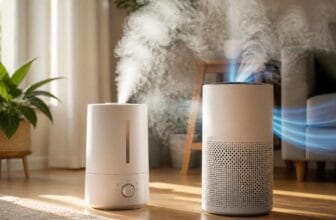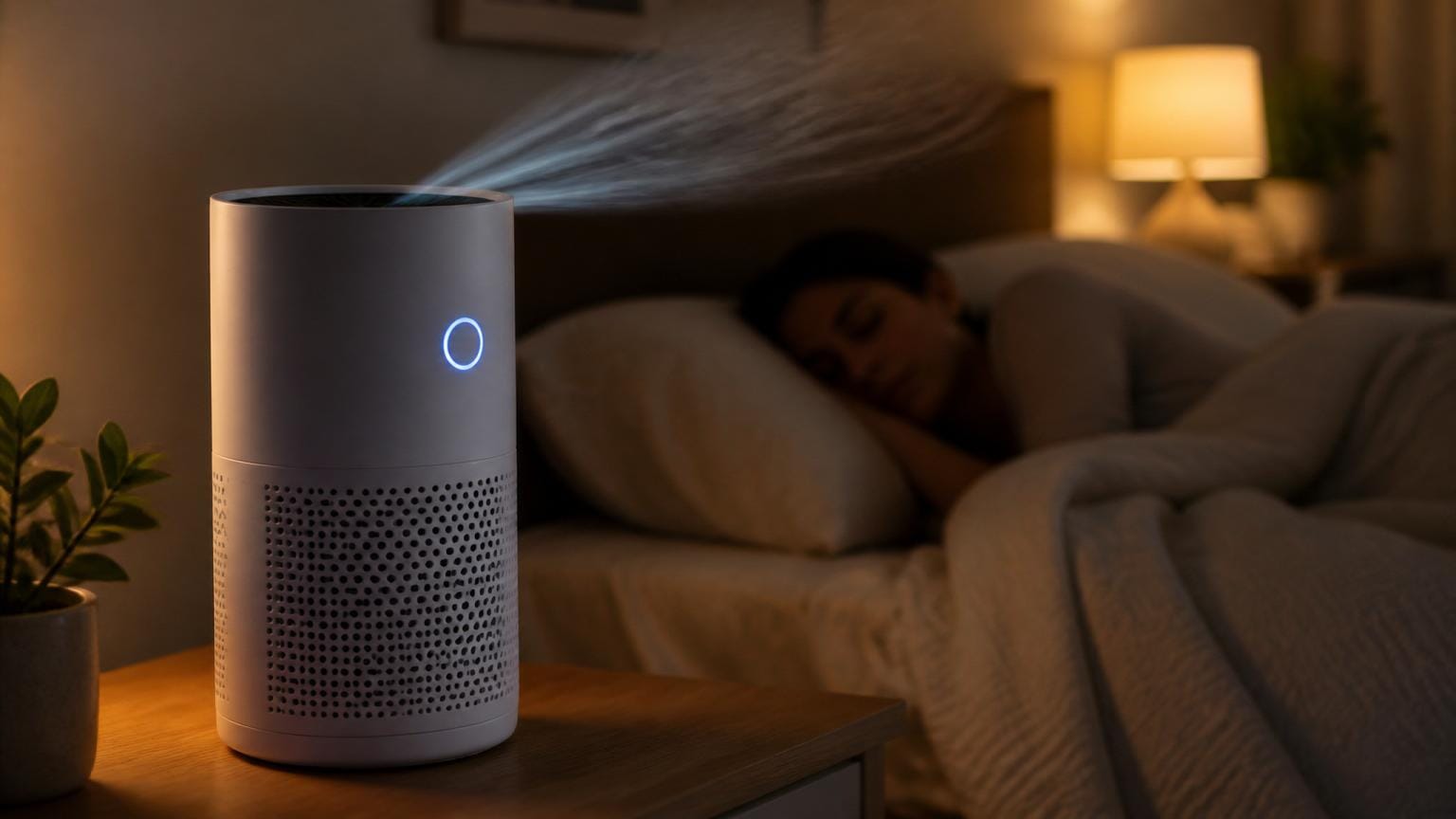
Nighttime hums that seem tiny can still fracture sleep.
A bedroom at 2 a.m.: everything else is still, but a faint, steady fan noise drifts from the corner and wakes light sleepers between sleep cycles. Sensitivity to low‑frequency hums is common; even when a purifier’s lights are dim, the temptation is to bump fan speed to chase cleaner air — and trade silence for airflow.
The core trade‑off is simple but consequential: noise at low speeds versus true filtration efficiency versus room coverage. The best choices reduce audible distraction at bedside (night modes, low dB), while delivering enough air changes for the room and using true HEPA plus carbon where needed. Prioritize machines that state night‑mode decibels and ACH/CADR so silence and clean air both hold up through the night.
- Aim for night noise ≤30 dB (whisper level).
- Target 4–5 ACH for bedrooms; calculate required CADR = room volume × ACH ÷ 60.
- Choose true HEPA (99.97% at 0.3 µm) and activated carbon for odors/allergens.


What ‘quiet’ actually means for sleep
Why A‑weighted decibels (dBA) matter
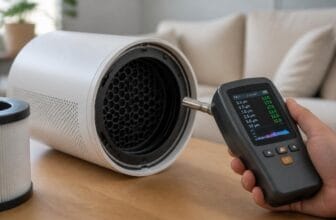
Manufacturers usually report sound in A‑weighted decibels (dBA) because the A‑weighting approximates human ear sensitivity across frequencies. dBA is the most useful single-number comparison when judging whether an air purifier will be sleep‑friendly.
Typical sleep thresholds
- <20 dBA: Extremely quiet — close to ambient in a very silent bedroom. Good for sensitive sleepers.
- 20–30 dBA: Very quiet — comparable to a whisper or rustling leaves. Matches the <30 dBA guideline often recommended for uninterrupted sleep.
- 30–40 dBA: Noticeable but tolerable for many; may bother very light sleepers.
- >40 dBA: Loud for a bedroom; likely to disturb sleep cycles for many people.
These bands are guidelines: perception depends on background noise and individual sensitivity. Also remember that a 10 dB change is perceived roughly as twice or half as loud.
Why frequency and tone matter as much as level
A steady broadband sound (like low steady fan noise) can be less disruptive than a quieter but tonal hum or high‑pitched whine. Low‑frequency rumble travels farther and can feel more intrusive even at the same dBA. Manufacturers’ dBA figures don’t show the spectrum; a model with similar dBA can sound very different.
How manufacturers report noise — what to compare
Compare the dBA at the lowest setting (or ‘sleep mode’) and note the measurement distance (often 1 m). Ignore peak or unspecified numbers. Prioritize models that list a sleep‑mode dBA and mention reduced tonal peaks or low‑frequency damping — those specs correlate with real‑world bedside quietness.
Look for dBA in sleep mode (lowest fan speed) at a specified distance.
Favor listings that describe tone or low‑frequency control, not just a single dBA number.
Treat anything under 30 dBA at night as a meaningful benchmark for bedrooms.
What to prioritise — and what to accept
Use this rapid screen before reading reviews
Noise: Night/sleep mode listed and ≤30 dBA (or manufacturer provides measured night dBA). Filtration: True HEPA (H13+) stated, or lab test data. CADR/ACH specified. Room match: CADR supports bedroom square footage at 4–5 ACH. Modes & sensors: Dedicated sleep/auto mode and timer or light dimming. Maintenance: Filter life and replacements clearly documented; no ozone generators.If a model fails two or more checks, deprioritise it for a quiet bedroom.
Powerful, whisper‑quiet purifier for bigger bedrooms
01 Ultra-quiet sleep mode with HEPA filtration
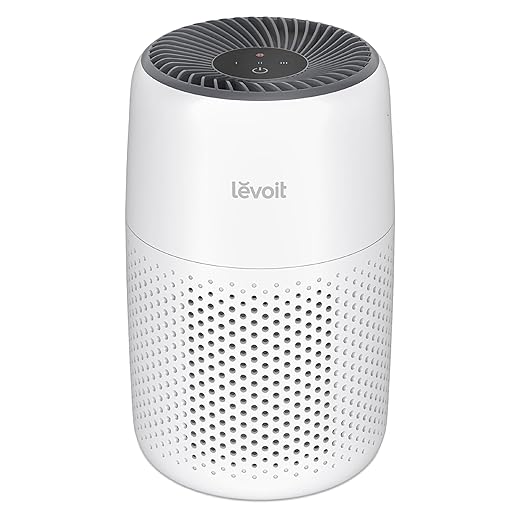
Levoit Core300‑P targets larger bedrooms and small apartments that need true HEPA filtration without a constant hum. AHAM/CADR‑rated coverage and a dedicated Sleep Mode let it run at manufacturer‑claimed noise floors while still using a 3‑in‑1 HEPA filter. Its tall, narrow body fits a bedside or corner but is sized to move more air than compact bedroom models.
- Very low claimed noise (sleep mode around 24 dB)
- HEPA‑grade filtration (99.97% at 0.1–0.3 μm, per independent lab notes)
- AHAM/CADR coverage aimed at larger rooms (manufacturer range listed)
- Compact footprint for the airflow it delivers (≈8.7″ square base)
- Replacement filters recommended every 6–8 months — ongoing cost
- Higher speeds required for maximum CADR increase noise and power draw
- Core300‑P lacks the smart connectivity found on some variants
Recommended when a larger bedroom requires near‑silent overnight filtration. Sleep Mode delivers manufacturer‑claimed low dBA while the unit retains HEPA‑grade filtration, making it suitable for light sleepers in rooms where higher CADR is needed. Expect modest ongoing costs from genuine replacement filters every 6–8 months and be prepared to trade off maximum ACH if keeping the purifier at the quietest setting.
Budget bedside mini: compact, quiet, portable
- Very quiet sleep mode
- Compact, portable footprint
- AHAM-verified filtration
- Aroma pad option
- Lower CADR than full-room units
- Best for near-field use only
- Won’t deliver 4–5 ACH in larger bedrooms
Mid-size HEPA purifier for allergy-prone bedrooms
Ozone-free filter with wide coverage
Purivortex Quiet HEPA positions itself as a balanced mid-size bedroom purifier for pollen and allergy concerns. Marketed with a true HEPA filter and ozone-free operation, it targets continuous allergen removal across typical mid-sized rooms rather than whole-house cleaning. Its mid-room CADR rating and a dedicated quiet/sleep mode aim to maintain multiple air exchanges while keeping noise low enough for many sleepers.
- True HEPA filtration captures pollen, dust, pet dander
- Ozone-free operation
- Mid-room CADR suited to typical bedrooms
- Dedicated quiet/sleep mode keeps noise minimal
- Recurring filter replacements required
- Not ideal for very large or open-plan spaces
- Feature set and controls are basic
Match model to room and placement
Quick comparison by room size and noise/CADR tradeoff
- Levoit Core300-P (best for large rooms) — Designed to deliver a higher CADR while keeping sleep-mode noise very low. Best when room area requires strong airflow; expect somewhat higher fan speeds for fast clearance, but night mode stays quiet enough for bedrooms.
- Levoit Core Mini-P (best budget option) — Extremely low low‑speed dB, compact footprint, but limited CADR. Ideal as a bedside unit in small rooms or for close‑proximity use where distance to the sleeper compensates for lower overall room turnover.
- Purivortex Quiet HEPA (best for mid-sized rooms) — Balanced mid‑range CADR with a quiet night mode aimed at allergy reduction. Good for medium bedrooms that need steady cleaning without high fan speeds.
Placement tips to reduce perceived noise and keep cleaning effective
- Bedside: place within 1–2 m of the sleeper so the purifier can run at lower speeds while achieving effective local air changes.
- Corner or elevated: corner placement can hide the unit but may reduce circulation; elevating the unit (table or stand) improves room mixing and often lowers perceived noise at bed level.
- Orientation and clearance: keep 30–60 cm (12–24 in) clear around intakes/exhausts and point exhaust away from the head to reduce direct sound. Avoid enclosed cabinets or tight alcoves that increase blower strain and noise.
Choose the model whose CADR meets the room area for 4–5 ACH, then use placement to lower fan speed and perceived sound without sacrificing air turnover.
Measure floor area and aim for a purifier CADR that supports 4–5 ACH for that room. If CADR is borderline, place the unit bedside and run at lower, quieter speeds for comfortable sleep.
Maintaining quiet performance
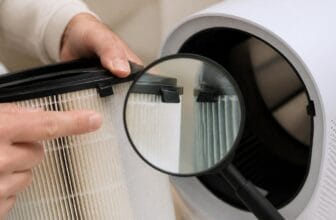
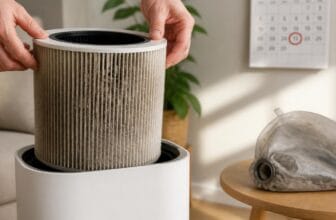
A drop in quiet performance usually starts with restricted airflow. Clogged or saturated filters force the fan to work harder, increasing RPM, motor noise and turbulent sound from the grille. Regular care preserves both sound and cleaning efficiency.
Routine maintenance
- Vacuum or wipe the pre‑filter every 2–4 weeks in dusty homes; check monthly otherwise.
- Replace true HEPA elements about every 6–12 months depending on use, indoor pollution and the model’s recommendations. Activated carbon cartridges often need replacement more frequently (roughly every 3–6 months) if cooking or heavy odors are common.
- Watch filter‑change indicators and airflow: a steady drop in output or a persistent filter light signals replacement.
Operating habits for quiet nights
- Run a short pre‑sleep purge (15–30 minutes) on a higher fan speed with the bedroom door closed to quickly achieve target ACH.
- Switch to sleep mode for the night to keep noise low while maintaining continuous air exchange. Continuous overnight operation beats switching the unit off and on for both noise and pollutant control.
For deeper guidance on replacement timing and HEPA choices, see the guides “filter changes for quiet models” and “HEPA levels to prioritise in bedroom units.”
Run boost for 15–30 minutes before lights‑out.
Ensure inlet/outlet clearance (no blankets or curtains).
Confirm sleep mode is engaged and filter lights are off.
Note heavy pollen/pet homes may need shorter replacement intervals.
Quick answers about sleeping with a purifier
Are these purifiers quiet enough for sleep?
Yes — manufacturers list low/sleep modes at or below the 30 dBA sleep threshold; verify the model’s listed low‑mode dBA. Perceived disturbance also depends on frequency and distance.
Which model fits room size and ACH needs?
Match CADR to room to reach 4–5 ACH. Core300‑P suits larger rooms, Purivortex mid‑size, Core Mini‑P for small/bedside use; use manufacturer CADR or AHAM guidance to confirm ACH.
Will they handle pollen and other allergens?
Manufacturers specify true HEPA filtration, effective for pollen and allergens when run to recommended ACH. For severe allergies, choose higher CADR and run a 15–30 minute pre‑sleep purge.
What maintenance and ongoing costs are typical?
Manufacturers list filter lifetimes and replacement costs; expect regular pre‑filter cleaning and periodic HEPA replacement based on use. Check manuals for washable pre‑filters and disposable HEPA specs.
Any safety or ozone concerns overnight?
These models are marketed as ozone‑free and use mechanical HEPA per specs; disable any ionizer/ozone modes if present. Confirm spec sheets for emissions and certification statements.
Decision checklist and first‑night setup
- Measure room volume (length × width × height) and target 4–5 ACH when choosing CADR.
- Verify lowest‑speed noise (dB) and a dedicated sleep mode—aim for ≤30 dB at night.
- Match CADR to room size: higher CADR for larger rooms (Levoit Core300‑P recommended). Small bedside needs: Levoit Core Mini‑P. Mid‑size/allergy focus: Purivortex Quiet HEPA.)
Top picks and when to pick them. Levoit Core300‑P is the best choice for larger bedrooms needing higher CADR and sustained ACH; Levoit Core Mini‑P fits small bedside use and tight budgets; Purivortex Quiet HEPA is the balanced mid‑size option for pollen/allergy concerns.
Quick actionable steps. Measure room volume and select a model whose CADR delivers 4–5 ACH, confirm sleep‑mode ≤30 dB, place the unit with a clear intake on a stable surface to minimise perceived noise, set reminders for filter changes. For the first night, run the purifier on high for 15–30 minutes to purge the room, then switch to sleep mode.