Not always essential — an air purifier helps only when airborne pollutants are measurable and persistent.
In a compact UK flat—small living room, a single bedroom—occasional hayfever, a thin dust film on surfaces, frying odours after cooking and a damp corner after heavy rain create doubt. The right decision depends on what is causing the problem (fine particles, pollen, VOCs, or moisture), how often it happens, and how high indoor humidity gets. A purifier targets airborne particles and some VOCs; it does not fix damp or stop sources of pollution.
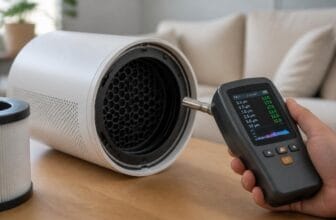
Measure the issue first: particle/pollen counts, frequency of odours, and relative humidity before committing to an appliance.
- PM spikes: repeated indoor particle spikes on multiple days or during known urban pollution episodes.
- Pollen link: symptoms that align with local pollen forecasts and worsen when windows are open.
- Humidity: persistent relative humidity above ~60% suggests moisture control (ventilation/dehumidification) is needed first.
Five-minute diagnostic: will a purifier help?
- Identify the pollutant
Note whether the issue is smoke, dust, pet dander, or damp/mould. If smoke is the main problem, check whether purifiers can remove smoke smell.
- Assess frequency
Is the problem constant or only occasional (for example, cooking events)? Persistent daily exposure makes a purifier more useful; rare incidents less so.
- Locate the source
Estimate which room concentrates the pollutants (living room, bedroom). A single-room problem is easier and cheaper to address with a purifier than whole-flat contamination.
- Check humidity and mould
If condensation or visible mould is present, a dehumidifier is a better first fix; see dehumidifier for mould in flat.
- Test ventilation and upkeep
If opening windows or removing the source substantially reduces the issue, a purifier may add little value. Also consider likely noise, filter replacement and maintenance.
Red flags against buying: problem is humidity/mould, intermittent single events, dominant outdoor pollution, or inability to maintain filters.
A short monitor run over a week helps decide whether particulate levels are persistently high.
Factor CADR versus room size and budget for regular filter replacements before committing.
Common indoor pollutants and the signs they cause
Typical pollutants and how they show up
- Particulate matter (PM2.5/PM10): from traffic that drifts indoors, cooking (especially frying), candles and smoking. Signs: fine dust on surfaces, a grey film on windows, and noticeable throat or eye irritation during or after peak cooking/traffic times.
- Pollen and household dust: enters through open windows, on clothing or from pets. Signs: seasonal sneezing, itchy or watery eyes, or symptoms that worsen when windows are open. For guidance on which air purifiers work best for pollen and dust, see which units cut pollen and dust most.
- VOCs (volatile organic compounds): from paints, new furniture, cleaning products and some glues. Signs: chemical or “new” smells, headaches, or temporary irritation after redecorating or heavy cleaning.
- Mould and damp-related spores: from condensation, leaks or poor ventilation. Signs: musty odour, dark spots on walls/ceilings, or persistent damp patches.
- Biological allergens and odours: pet dander, food smells or cooking grease. Signs: lingering odours, visible grease build-up near the hob, and allergy-like reactions in sensitive people.
Quick tips to narrow the problem: note when symptoms occur (time of day, after cooking or opening windows), check for visible dust/mould, and record any strong smells. This helps decide whether filtration (HEPA for particles, activated carbon for gases) or ventilation/dehumidification is the priority.
What each purifier technology does
- True HEPA
Fibrous filters that mechanically trap airborne particles (dust, pollen, smoke, many aerosols). Filter grade matters for capture efficiency and is a primary specification for particle removal.
- Activated carbon
Porous carbon that adsorbs gases, odours and many volatile organic compounds (VOCs); effectiveness depends on carbon quantity and surface treatment.
- Ionisers
Emit charged ions that make particles clump and settle or attach to surfaces; can reduce airborne particulates but may produce ozone and surface residue as trade-offs.
- UV (germicidal)
Ultraviolet-C light can inactivate microbes in an airflow path but requires correct intensity, exposure time and safe containment; not a substitute for particle filtration.
True HEPA for particles. A certified, true HEPA filter is the most important feature for reducing airborne particles in a typical flat. For guidance on specific filter levels and their practical differences, see the differences between H13 and H14 filters.
Activated carbon for smells and VOCs. Gas-phase pollutants and persistent cooking or renovation odours respond to carbon adsorption; capacity and replacement frequency determine real-world performance.
Ionisers and UV are specialist tools. Ionisers can lower airborne particle counts but may generate ozone and leave dust films — assess health-related trade-offs and ventilation implications; consult independent advice on ioniser safety guidance. UV-C units can inactivate microbes when installed to treat moving air safely, but require correct engineering and do not remove particles or gases by themselves.
Practical takeaway:
Prioritise a reputable HEPA filter and adequate air flow (CADR) for particle problems. Add activated carbon if smells or VOCs are present. Treat ioniser and UV features as specialised options with maintenance and safety trade-offs.Sizing and placement: get the fit right
How to size by room and airflow
Select a purifier rated for the room’s volume, not just floor area. Manufacturers list Clean Air Delivery Rate (CADR) in cubic metres per hour (m³/h); required CADR ≈ room volume × desired air changes per hour (ACH). For typical flat use, 2–3 ACH is often adequate; for allergy, smoke or heavy cooking particles aim for 4–6 ACH. For a sense of scale and examples, consult the guidance on what size air purifier do I need for my living room?.
Open-plan areas need higher CADR or multiple units. If a single unit is chosen for several connected rooms, size for the combined volume.
Where to place the purifier
Placement affects delivered airflow and noise more than many expect. Key principles:
- Keep inlet and outlet clear (at least 30 cm) so airflow isn’t restricted.
- Elevate the unit slightly (table or stand) for bedrooms and living rooms; many models perform poorly tucked on the floor.
- Position near the pollution source for source control (kitchen doorway, pet area) or near the breathing zone in bedrooms.
- Avoid corners, behind furniture, or directly against walls — obstructions can cut effective CADR by 20–50%.
Filters degrade over time; performance falls if filters are clogged—follow the maintenance schedule in the manual and read more on how often replace air purifier filter to keep capacity reliable.
Quick checklist: calculate room volume, pick CADR for desired ACH, place unobstructed and near source or sleeping area.
Common myths about filters and features
HEPA captures particles only; activated carbon or chemisorption is needed for VOCs and smells.
HEPA fibers trap particulates down to ~0.3 µm but do not adsorb gases; carbon beds remove many common household VOCs and odours.
Effectiveness is room‑by‑room; CADR and ACH determine coverage.
A unit sized for a living room cannot maintain target air changes in other rooms simultaneously; placement near pollutant sources matters.
Home UV implementations often have limited exposure time and variable efficacy.
Many consumer devices lack the lamp intensity or controlled airflow needed for disinfection; see the in-depth review of UV effectiveness in home purifiers.
Lifespan varies with pollutant load; visible dirt, odours or reduced airflow indicate replacement is due.
High particle or VOC levels shorten filter life; sensors and regular inspection give a more accurate replacement schedule than calendar dates.
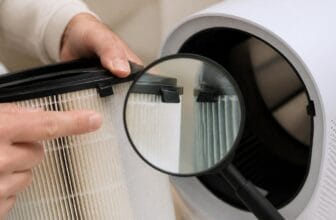
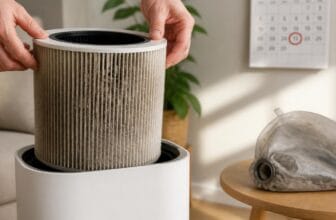
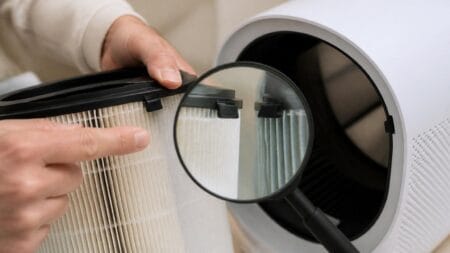
Inspect prefilters monthly and clean or vacuum washable types. Typical replacement windows: HEPA commonly 6–12 months, carbon 3–6 months — shorten intervals with heavy use. Watch for signs of reduced performance:
increased dust settling on surfaces persistent odours returning noticeably reduced airflow or louder fan noise filter indicator lights or persistent error codesConfirm model numbers, OEM markings and seller reputation before buying replacements; refer to the step‑by‑step guide to spotting fake filters when in doubt.
Living with a purifier: noise, sleep and humidity
Noise and sleep
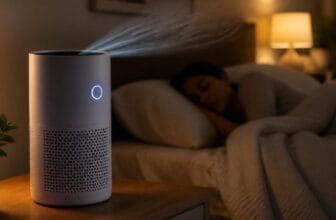
Acceptable bedroom sound depends on sensitivity and local background noise, but aim for sleep modes in the ~20–35 dB range to avoid disturbance. Many manufacturers list decibel figures at each fan speed; compare those numbers and look for models with tested low‑noise operation, such as the quiet options for bedrooms.
Quiet modes reduce airflow, so continuous low‑speed operation often gives better overnight performance than intermittent high‑speed bursts. Practical habits:
- Run higher speed after cooking or guests, then switch to sleep or auto overnight.
- Use timers or smart scheduling to match occupancy patterns.
- Place the unit away from the bed if a faint hum is still noticeable.
Pairing with humidifiers and dehumidifiers
Keeping relative humidity around 40–60% helps comfort and can reduce some biological pollutants. When combining devices, avoid directing humidifier mist straight into the purifier intake and check that filters won’t become damp. For detailed considerations on mixing humidification with filtration, consult the detailed humidity guidance.
Small compromises—short high‑speed runs and sensible placement—balance cleanliness with comfort in a flat.
Quiet mode lowers fan speed and CADR.
Run high speed briefly after pollutant events, then return to sleep mode. Use continuous low operation overnight rather than long off periods.Quick buying checklist
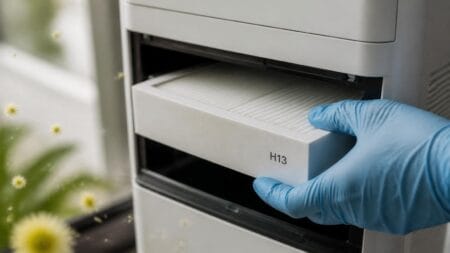
- True HEPA filtrationSelect units with a certified HEPA rating (H13 or H14) for reliable removal of fine particles such as pollen, dust and many aerosols. Manufacturers vary in claims, so check the exact class rather than marketing terms.Look forCertified H13/H14 HEPA mediaAvoidGeneric ‘HEPA‑like’ or unverified claims
- CADR/ACH and room fitMatch Clean Air Delivery Rate (CADR) or Air Changes per Hour (ACH) to the flat’s room volume for effective cleaning; a unit that’s too small will have negligible effect. Prefer models with clear CADR numbers and guidance for room size.Look forCADR/ACH matched to room volumeAvoidNo performance figures or vague room claims
- Activated carbon & humidity compatibilityChoose a model with an activated carbon stage when odours or volatile organic compounds (VOCs) are concerns; ensure the unit tolerates typical flat humidity and any co‑used humidifier. If using a humidifier, confirm combined use recommendations in product materials.Look forCarbon filter stage and clear humidity specsAvoidNo carbon option when odour/VOC removal is needed
- Safety, ozone and filter sourcingAvoid ionisers that emit ozone above recognised safety guidance; prefer mechanical filtration. Verify that replacement filters are genuine, available locally or online, and clearly labelled to prevent counterfeit or incompatible parts.Look forLow‑ozone operation and genuine replacement filtersAvoidIoniser‑only units with unspecified ozone output
Which metrics matter—and why
Priority metrics selected from independent test standards and industry guidance: HEPA class, CADR/ACH, activated carbon for gases, ozone limits, and authentic filter availability. These predict real‑world performance more reliably than marketing buzzwords.
- HEPA rating first
HEPA class (H13/H14) indicates particle capture efficiency; higher classes remove a larger share of submicron particles.
- CADR/ACH next
CADR shows volume cleaned per minute; ACH links that to room size—both are needed to size a unit for a flat.
- Safety and sustainment
Check ozone output and whether replacement filters are genuine and stocked; long‑term availability affects sustained performance.
Metrics ordered by practical impact on indoor air quality.
Three‑step action plan
- Test during typical peak exposures (after cooking, when damp, or during cleaning) to capture real-world pollution patterns.
- Choose independently certified HEPA (H13/H14) plus substantial activated carbon; avoid ozone‑producing ionisers.
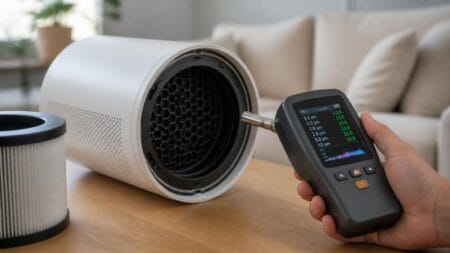
- Log filter purchase dates and periodic meter readings; replace filters when indoor particulate/odour readings stop improving.
Run the diagnostic. Use the five‑minute checklist at peak exposure times—note visible dust, odours, cooking/vaping frequency, humidity and any PM2.5/CO2 readings; identify the worst room.
Pick a true HEPA + carbon unit sized to the room. Match CADR/ACH to room volume, confirm H13/H14 (or equivalent) HEPA and genuine activated‑carbon filters, and choose a fan speed that keeps noise acceptable for the space.
Set a maintenance and verification plan. Log runtime and filter changes, set calendar reminders, inspect prefilters/carbon for saturation, and periodically recheck PM2.5/odour/CO2 to verify ongoing effectiveness.