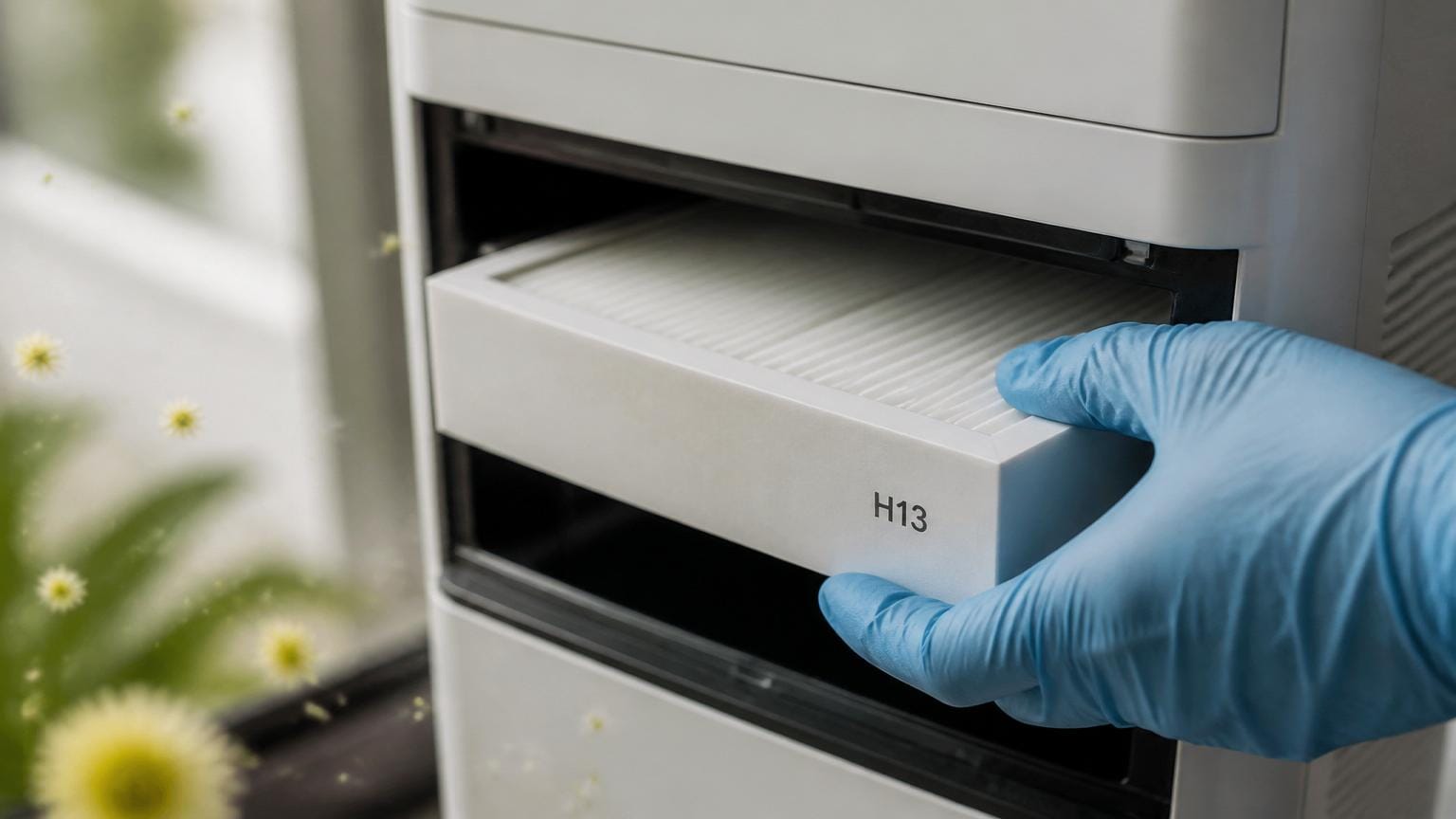
When every percentage point feels like an allergy lifeline.
Standing in the aisle, a shopper sees boxes labelled H13 and H14 and wonders whether the tiny-sounding gap justifies a pricier unit. Laboratory ratings are close; real-world factors — fit, airflow, and maintenance — often determine how much allergy relief appears. This is informational, not medical advice.
- H13 filters are tested to ~99.95% efficiency at the most penetrating particle size.
- H14 is ~99.995% — roughly a tenfold reduction in particles at MPPS; sealing and CADR matter more in-room.
EN1822 and MPPS: what the ratings actually measure
EN1822 is the European standard that defines HEPA and ULPA classes by laboratory tests. Rather than a vague “efficiency,” EN1822 specifies how a filter performs when challenged with test aerosol at the most penetrating particle size (MPPS) and checks for leaks across the whole filter element.
MPPS explained. The MPPS is the particle diameter that passes through a given filter most easily—where mechanical capture mechanisms (diffusion, interception, impaction) are least effective. For common mechanical HEPA media the MPPS is often around 0.1–0.3 micrometers, though it varies with flow and filter design.
Key implications:
- H13 (99.95%) and H14 (99.995%) are efficiencies measured at the MPPS, not a blanket capture rate for every particle size.
- Filters will typically capture higher fractions of both larger and much smaller particles than at the MPPS.
- Real-world performance depends on installation, air flow, leaks and aging—lab numbers assume ideal test conditions.
For broader context on air-cleaning options and trade-offs, compare HEPA vs ioniser safety and effectiveness.
From filter efficiency to room performance
How lab efficiency turns into clean air
A filter’s EN1822 efficiency (H13 vs H14) is a material property measured at the MPPS. Real-room performance depends on three system-level variables: airflow, sealed design, and CADR/ACH.
- Airflow: a high-efficiency filter removes a greater fraction of particles that pass through it, but the volume of air moved matters. Low fan speed or high resistance reduces cleaned air per minute.
- Sealed design: leaks or bypass around the filter let uncleaned air recirculate. Even a near-perfect H14 element delivers little benefit if the housing or ductwork leaks.
- CADR and ACH: CADR (clean air delivery rate) approximates the product of airflow and particle removal fraction; it is the metric that scales filter efficiency to room cleaning. ACH (air changes per hour) = (CADR × 60) / room volume. Higher CADR or ACH means faster particle reduction.
Practical effect
A nominal H14 filter (99.995% at MPPS) in a low-flow unit may produce a lower CADR than an H13 in a high-flow, well-sealed air cleaner. The lab advantage is only realized when the device moves enough air and prevents bypass.
Quick checks to preserve the advantage
- Verify CADR and match it to room volume for desired ACH.
- Inspect seals and gaskets; ensure proper filter fit.
- Replace or clean prefilters to avoid airflow loss.
- Avoid undersized units or very low fan settings for large rooms.
Even a small bypass or steep airflow drop can negate incremental efficiency gains.
Do H14 filters improve allergy symptoms compared with H13?
What the studies show
Controlled-environment and laboratory studies consistently demonstrate that H14 media remove a slightly higher fraction of the smallest particles than H13 when tested at the filter face (EN1822 conditions). However, peer-reviewed clinical trials directly comparing H13 to H14 for allergy symptom outcomes are scarce. Trials that measure airborne allergen concentrations or particle counts often find measurable reductions with higher-efficiency filters, but translation to meaningful decreases in validated symptom scores is inconsistent or absent.
Important caveats that limit generalization
- Study setting: many results come from sealed chambers or idealized test rooms, not lived-in homes with variable leakage.
- Endpoints: surrogate measures (particle counts, allergen load) are not equivalent to patient-reported symptom relief.
- Population and exposure: effects differ by allergen type (pollen, pet dander, dust mites) and individual sensitivity.
- System factors: CADR/ACH, filter fit, bypass/leakage, and maintenance have larger real-world impact than small per-filter efficiency gains.
- Practical trade-offs: higher-efficiency media can increase pressure drop, reduce airflow, or raise noise if fan speed is not adjusted.
- Study quality: few adequately powered randomized trials isolate filter grade as the sole variable.
In summary, research shows H14 captures more particles in test conditions, but evidence that this consistently produces clinically meaningful allergy symptom improvements over H13 in real-world settings is limited.
Higher lab efficiency does not guarantee better symptom relief. Prioritize adequate airflow (CADR/ACH), sealed installation, and regular maintenance; filter grade is secondary in everyday environments.
A practical, numbered selection workflow
-
1) Measure the room and set an ACH target
Calculate room volume (floor area × ceiling height). For routine allergy control aim for about 4–6 air changes per hour (ACH); for higher sensitivity consider 6–8 ACH.
-
2) Convert ACH to CADR and add margin
Required CADR (m3/h) = room volume × desired ACH ÷ 60. Round up 10–20% to allow for furniture, obstructions and real-world losses.
-
3) Verify sealed design and installed CADR testing
Confirm the unit seals around the filter (gaskets, closed housing) and that the listed CADR was measured with the filter installed. Avoid designs where air bypass or removable open frames could reduce effective performance.
-
4) Request EN1822 certification and MPPS data
Ask the manufacturer for the EN1822 certificate and a test report showing efficiency at the filter’s MPPS and across particle sizes. Prefer independent lab reports that identify H13 or H14 at the MPPS.
-
5) Balance noise and practical runtime
Compare reported dBA at the fan speed that reaches the required CADR; select a speed that can run continuously without unacceptable noise. Continuous low-speed operation often outperforms intermittent high-speed bursts.
-
6) Factor maintenance, prefilters and placement
Choose units with easy filter access, a prefilter to extend HEPA life, and clear placement (near pollutant sources or central in the room). Include realistic replacement intervals when sizing long‑term performance.
Do these five checks before deciding.
Calculate CADR: CADR = volume × ACH ÷ 60. Aim for the CADR at which the unit will actually run. Get EN1822/MPPS proof: Request the certificate and MPPS efficiency curve. Confirm sealed housing: Look for gaskets and manufacturer statements about installed CADR testing. Check noise at operating speed: Use the dB rating for the speed that meets CADR. Prefer a prefilter and easy access: Lowers cost and keeps HEPA working at rated efficiency.Beware marketing terms like “HEPA‑type” or “HEPA‑like” without EN1822 backing.
Common HEPA marketing claims — what’s true and what to check
Only filters tested and certified to EN1822 with MPPS results guarantee H13 or H14 efficiencies.
Request the EN1822 test report from an accredited lab, including MPPS efficiency curve and report/serial numbers; avoid vague terms like “True HEPA” without documentation.
Laboratory efficiency differs slightly; real-world benefit depends on CADR, room ACH, and filter housing/fit.
Check CADR/ACH claims and measured air changes for the target room alongside EN1822 class; grade alone doesn’t ensure better results.
Labels can be misapplied; performance falls with leaks, loading, or incorrect installation.
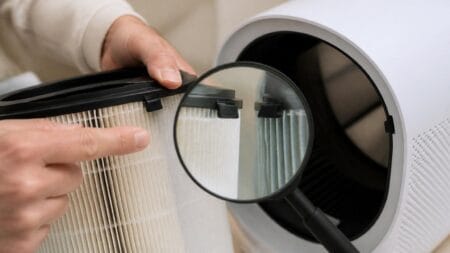
Ask for leakage/fit test results or in-situ particle-count measurements after installation, and confirm the tested model and serial match the unit being sold.

Pressure drop, loading and real‑world lifespan
Higher-efficiency HEPA grades (H14 vs H13) typically have a higher pressure drop at a given airflow because the media is denser and captures a greater share of small particles. That extra resistance increases fan work and can reduce delivered airflow if the unit cannot compensate.
Loading rate and lifespan
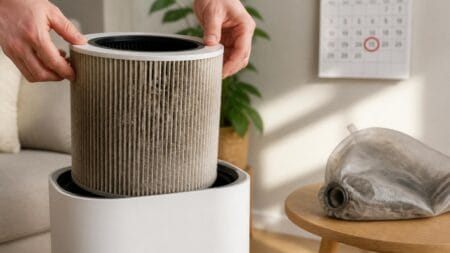
Because H14 media removes more particles per pass, it often loads faster in particle-rich environments. Loading depends on indoor pollutant concentration, presence of a prefilter, and whether the housing is well sealed. A shorter functional life does not mean poorer value—capture efficiency, energy use, and replacement cost must be balanced.
Practical monitoring and cost factors
Useful, non-prescriptive indicators of impending replacement include rising noise or fan speed, measurable airflow drop, increasing differential pressure, or higher particle counts downstream. Maintenance choices that affect long‑term cost:
- adding a washable prefilter to trap large particles
- using a differential pressure gauge or particle counter for objective checks
- choosing a fan capable of maintaining required CADR despite higher pressure drop
Operational costs combine extra energy use, more frequent filter changes, and disposal. In many residential settings, an H13 with good sealing and prefiltration offers the best long‑term balance; H14 remains appropriate where maximal capture outweighs those costs.
Noticeable drop in airflow or louder fan noise
Rising differential pressure on a gauge
Visible darkening of the prefilter
Particle counter shows higher downstream counts
Quick decision checklist
- Match CADR/ACH Measure room volume, calculate required ACH/CADR for allergy reduction, then select a unit rated to meet that airflow in real use.
- Verify Certification Request the EN1822 report and evidence of sealed installation or leakage testing; efficiency claims should cite MPPS test data.
- Balance Practical Factors Compare noise, pressure drop and expected lifespan; higher efficiency can increase resistance and operating cost.
Final guidance and next steps
- Prefer matched performance (CADR/ACH + certified efficiency) over choosing H14 by label alone.
- Obtain manufacturer EN1822 reports, AHAM CADR listings, or independent particle‑count test reports before buying.
Match certified filtration to exposure needs, not just the highest H‑class. Confirm CADR/ACH and leakage performance for the actual room, check EN1822 certificates and third‑party CADR or particle‑count reports (manufacturer datasheets, AHAM listings, or accredited labs). For ongoing effectiveness, monitor airflow and replace or service filters per pressure‑drop or particle‑count indicators.