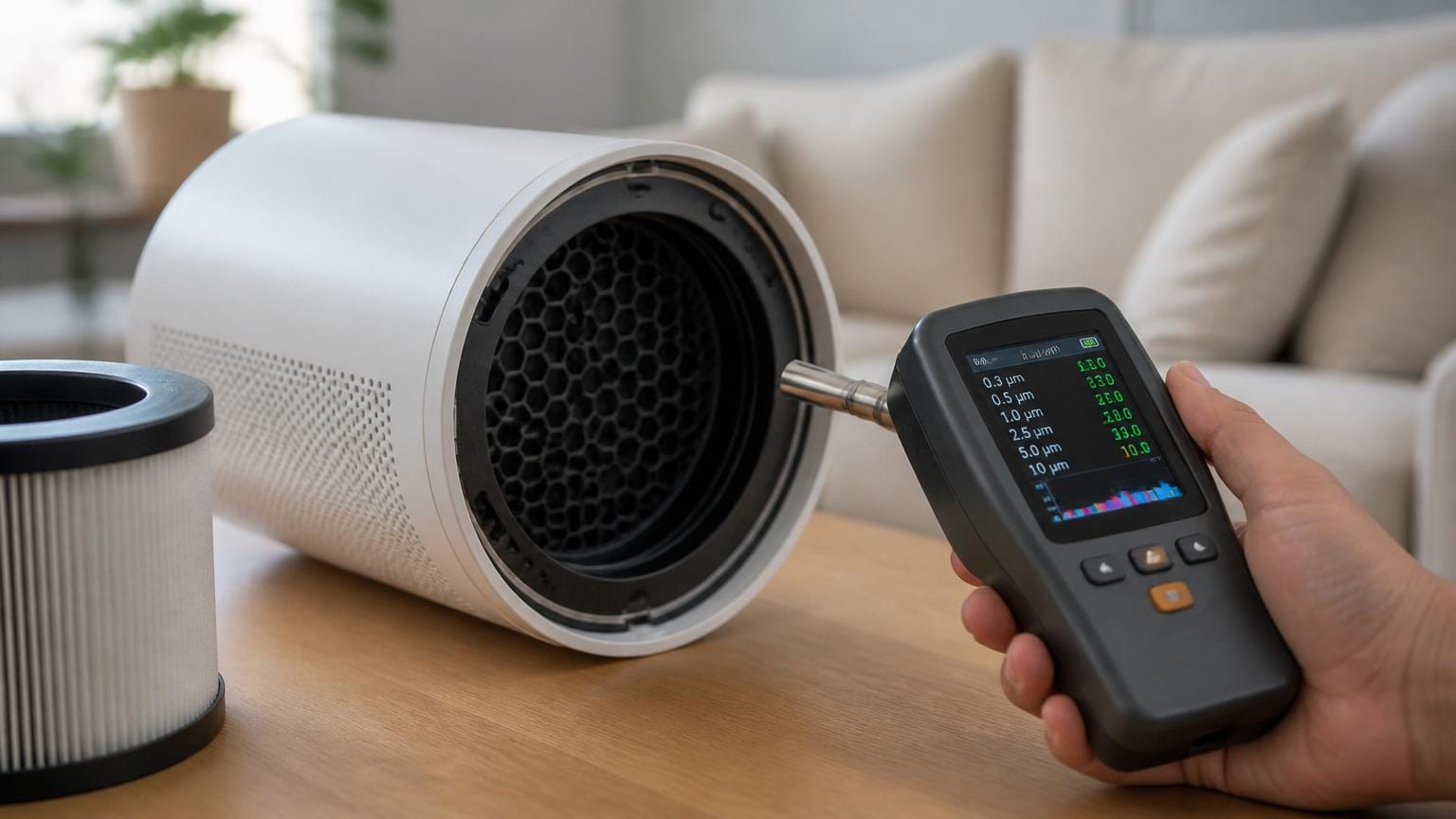
Bright numbers on a box rarely translate to the living room.
A shopper in an appliance aisle, phone in hand, toggles between CADR and ACH numbers and pauses. CADR reports cubic feet per minute from a lab; ACH reports air changes per hour for a room. Furnished, leaky, or L-shaped rooms, plus placement and airflow patterns, often cut effective performance — sometimes dramatically. That mismatch explains why a high CADR model can feel underwhelming and why an ACH target from a spec sheet may not deliver. Understanding each metric’s measurement and limits helps choose wisely.
- CADR comes from sealed, empty test chambers with ideal mixing.
- ACH depends on cleaner flow divided by room volume and assumes perfect mixing.
- Furniture, open doors, leaks and poor placement often cut effective removal 20–50%.
Definitions: CADR, ACH and related terms
- CADR (Clean Air Delivery Rate)
Volume of pollutant-free air delivered per minute, in cubic feet per minute (CFM). Determined in standardized chamber tests (e.g., AHAM), not measured in-room.
- ACH (Air Changes per Hour)
Number of times room air is replaced per hour (h⁻¹). A derived value computed as (CFM × 60) / room volume, or measured by tracer-decay in real spaces.
- CFM (Cubic Feet per Minute)
Volumetric airflow unit used for fan output and CADR. Measured directly with flow instruments and used to compute ACH.
- Particle-size categories
Bins by diameter in micrometers (e.g., >10 μm, 2.5–10 μm, 0.3–1 μm) or PM2.5 mass. Removal efficiency and CADR vary strongly with size; specifications often list size-specific CADR.
- Room volume
Space volume in cubic feet or meters (length × width × height). Used to convert CFM/CADR into ACH; effective volume can differ due to obstructions and airflow patterns.
How CADR and ACH numbers are produced
CADR values come from AHAM laboratory chamber tests that use standardized aerosol sources, controlled mixing, and a sealed, minimally obstructed room; these conditions isolate single-pass filtration performance and exclude real-room leakage, furniture, and aged filters. ACH is reported two ways: a calculated ACH divides device airflow (CFM) by room volume, while a measured ACH comes from particle-decay tests that track how quickly concentrations fall in an actual space.
-
AHAM CADR lab constraints
Tests run in engineered chambers with repeatable aerosols, fixed fan settings, and near-ideal placement—useful for apples-to-apples comparison but not a guarantee of in-home results.
-
Calculated vs measured ACH
Calculated ACH is convenient but assumes perfect airflow and no leaks; measured decay (using particle counters) captures infiltration, imperfect mixing, and placement effects and is therefore more realistic.
-
Conditions that inflate reported numbers
Small, sealed test rooms, new filters, no furniture blocking flow, and tight seals all make CADR/ACH look better than they will in lived spaces—filter loading and bypass quickly reduce performance.
Empty if not needed
Filter loading reduces CADR over time and increases pressure drop, lowering actual ACH. Consider two simple habits:
Track cumulative run hours and inspect filters visually for dust loading. Use measured decay tests when possible to verify in-room ACH, and consult guidance on how ACH affects filter replacement intervals for planning replacements.Four common misconceptions
They are lab benchmarks, not guarantees.
Sealed chamber tests exclude leaks, furniture, and real airflow.
Performance depends on placement and mixing.
Blocked intakes or poor circulation prevent whole-room exchange.
Calculations ignore leakage, filter loading, and imperfect mixing.
Actual decay tests usually show lower air changes.
CADR is about particles; gases and viability need other tests.
Gases require sorbents; pathogen risk depends on viability, not just particle count.
Step-by-step: convert CADR/CFM to expected room ACH
-
1. Measure room volume
Multiply length × width × height to get cubic feet (or metres). For irregular spaces, split into simple shapes and sum volumes. Note ceiling fans, open doors, or large alcoves that change effective mixing.
-
2. Select the pollutant class
Choose the CADR value that matches the target particle size (commonly reported for smoke, dust, and pollen). Use the CADR for the particle class most relevant to the concern, since CADR varies by particle size.
-
3. Convert CADR/CFM to ACH
If CADR is in cubic feet per minute (cfm): ACH = (CADR × 60) / room volume (ft³). If CADR is in cubic metres per hour (m³/h): ACH = CADR / room volume (m³). Example: a 2,000 ft³ room with a 200 cfm CADR yields (200×60)/2000 = 6 ACH (theoretical).
-
4. Use CADR at the chosen fan speed
Manufacturers report CADR at specific fan settings—use the CADR value for the speed that will be used in the room. Lower fan speeds reduce CADR; if only maximum CADR is given, expect lower real CADR at quieter settings.
-
5. Adjust for placement and obstructions
Placement near walls, behind furniture, or in corners lowers effective cleaning by reducing air mixing. Real-room tests and field studies typically find 20–50% lower removal than lab CADR/ACH because of imperfect mixing and obstructions.
-
6. Combine multiple units and interpret the result
For multiple identical units, sum their CADRs first, then apply the ACH formula. Treat the calculated ACH as an upper bound; apply a conservative reduction (for example, reduce by 20–50% depending on placement and mixing) and consider decay-based measurement to confirm real performance.
Formulas: ACH = (CADR [cfm] × 60) / Volume [ft³]; or ACH = CADR [m³/h] / Volume [m³]. Calculated ACH is a theoretical maximum—expect lower real-world values.
When to prioritize CADR or ACH
Different situations call for different metrics. Use CADR when the goal is rapid removal of a specific particle class in a single, enclosed room—for example, clearing smoke or cooking particles after a short event. Use ACH when assessing sustained dilution across an occupied space, planning for continuous sources, or comparing whole-room ventilation performance.
Quick decision guide
- Short bursts or single-room events: prioritize CADR for the particle size of concern and verify the unit’s CADR rating at that size.
- Ongoing sources or occupied spaces: prioritize ACH targets (air changes per hour) that match occupancy and exposure risk.
- Open-plan or multiroom spaces: treat ACH as more informative; one high-CADR unit may not produce uniform cleaning.
Edge cases to watch
- Continuous smoke or woodstove emissions require both high CADR and a verified ACH to prevent accumulation.
- Leaky rooms and open doors reduce effective ACH—measured decay rates or multiple units are better indicators.
- For final assurance, use measured decay tests rather than relying solely on lab CADR/ACH numbers.
Practical Q&A: purchase and placement
Is a portable air cleaner effective for wildfire smoke?
Wildfire smoke is primarily fine PM2.5; choose a true HEPA or high-MERV filter with a high fine-particle CADR. Run the unit at the highest tolerable speed, keep doors and windows closed, and prioritize rooms where occupants spend most time—field studies show removal needs increase substantially during heavy smoke events.
Is it better to run one unit on high or multiple units on low?
Multiple units distributed around a space usually provide better mixing and lower noise than one unit at maximum speed. Two smaller units at moderate speeds often match or exceed a single high-speed unit’s effective ACH, because summed CADR and improved circulation reduce dead zones.
Why is measured ACH often lower than CADR-based calculations in furnished apartments?
Furniture, surface deposition, leaks and imperfect mixing reduce real-world removal; empirical studies and decay tests commonly find 20–50% lower effective ACH than lab-derived estimates. Treat CADR-converted ACH as an upper bound and confirm performance with a particle counter or tracer decay when possible.
Where should a unit be placed in a furnished room?
Place units near likely pollutant sources or along main airflow paths, keep intakes/exhausts unobstructed, and elevate slightly off the floor (about 0.5–1 m) to improve circulation. For open or long rooms, distribute units rather than clustering one device.
How to size a unit for bedrooms versus living rooms?
Size to meet the target ACH for the specific room volume and occupancy; bedrooms often need quieter operation, so consider slightly higher total CADR (or an extra unit) to allow lower-speed, quieter settings while maintaining desired ACH. Prioritize occupant exposure times when allocating capacity.
Final checklist & recommendation
- Measure: record room dimensions and baseline particle or CO2 levels; note occupancy patterns.
- Compute: convert chosen CADR to expected ACH for the room and set a target ACH (account for real‑world loss).
- Place: position the cleaner for unobstructed intake/exhaust and near pollutant sources or central flow paths as appropriate for the space layout.
CADR predicts particle‑class removal; ACH measures whole‑room turnover. Use CADR when targeting specific pollutants (smoke, dust); use ACH for dilution in occupied or open spaces. The practical verdict: combine both — buy to CADR, verify to ACH.
Follow the five‑step checklist below to implement the recommendation and retest performance after installation.