A tempting clean-air claim can hide real safety trade-offs.
On a damp evening in a compact UK flat, a parent spots an online ad for an ioniser boasting “chemical‑free” air. Curiosity collides with concern: headlines about ozone formation and mixed performance data leave decision‑makers unsure.
The tension is concrete — ionisers can lower some particles but may produce ozone, regulations and labelling remain patchy in the UK, and many households include vulnerable people (young children, older adults, people with respiratory conditions) or pets. This section focuses on practical safety steps and what to check before running an ioniser at home.
How ionisers work and the safety tradeoffs
Ioniser air purifiers create charged ions (usually negative) or use a small electrical discharge. Those ions attach to airborne particles—dust, pollen, droplets—so the particles either clump together and fall out of the air or are attracted to a charged collection plate. That physical process is simple: charge a particle, change its behaviour.
One safety tradeoff is ozone production. Some ionisers, especially those that use corona discharge, generate ozone as a by‑product. Ozone is a respiratory irritant at relatively low concentrations, so measured ozone emissions and independent test data matter when assessing a unit’s safety.
Another pathway is redeposition: charged particles often settle onto walls, curtains and furniture instead of being removed from the environment. Airborne counts can drop while surface contamination rises, altering exposure routes. See research on ioniser effects on pollen and dust for examples of these shifts.
Finally, performance claims can be misleading. Vendors may quote ion counts or idealised removal percentages from lab tests that do not reflect real rooms. The most useful evidence is third‑party measurements of particulate removal (for example, CADR or equivalent room tests) combined with documented ozone emission figures.
Practical takeaway: weigh real‑world particle removal data and low ozone output rather than marketing claims alone.
Warning: some ionisers produce ozone. Prefer devices with verified low ozone emissions and independent test results; users should avoid units that list ozone generation as their main feature.
Regulatory and public‑health context
Regulatory coverage for ionisers is patchy. In the UK, product safety is enforced by the Office for Product Safety and Standards and public‑health guidance comes from UKHSA; internationally, WHO, the US EPA and California’s CARB publish guidance and exposure limits. Many countries rely on CEN/ISO test methods or national certification schemes.
When assessing safety claims, prioritise independent, room‑scale test results, measured ozone emissions reported in standard units (ppb or µg/m3), and transparent test methods. Certifications or CE/UKCA markings permit sale but do not guarantee real‑world performance.
Start with the do I need an air purifier—safety overview and cross‑check manufacturer statements against third‑party lab reports, regulator notices, and peer‑reviewed studies.
Be sceptical of broad health claims (for example, “kills viruses”) unsupported by independent, room‑level data. Prefer devices that publish test reports, specify ozone output, and compare results to recognised exposure limits.
Always verify:
Measured ozone levels and the units used Independent, room‑scale test reports (not only chamber tests) Named regulators, test labs or recognised standards citedStep-by-step checklist for operating an ioniser safely
- Pick the right room
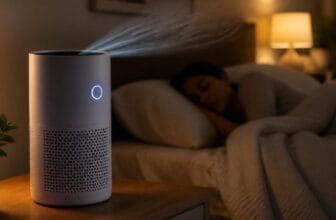
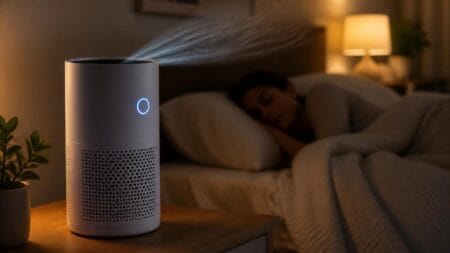
Run ionisers in well‑ventilated rooms that are not continuously occupied. Avoid use in sleeping areas, children’s rooms, or rooms where medically vulnerable people spend long periods.
- Ensure ventilation before, during and after
Confirm the ability to increase fresh air (open windows, use extract fans or MVHR where available). Allow a period of air exchange after a run to dilute any residual gases or charged particles.
- Use short, low‑output runs
Select the lowest setting that meets the cleaning goal and keep sessions short rather than continuous. Prefer intermittent operation and avoid prolonged overnight use unless independent testing shows negligible ozone.
- Place the unit safely
Position the device on a stable, elevated surface with clear space around intake and outlet (roughly 30 cm where possible). Keep it away from direct proximity to people, pets, plants and sensitive electronics.
- Follow maintenance and manufacturer instructions
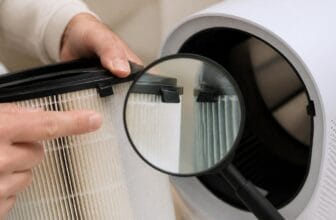
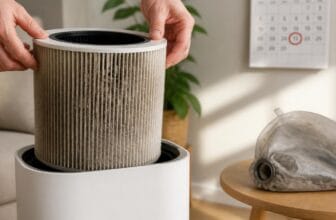
Unplug before cleaning. Clean or replace collectors and filters exactly as the manual directs, inspect for damage, and keep documentation of service. Stop using a unit with exposed wiring, overheating or unusual odours.
- Stop using if safety indicators appear
Cease operation if occupants notice persistent eye, nose or throat irritation, a sharp chemical smell, an ozone monitor shows concentrations above national guideline levels, or the device malfunctions. Seek independent testing or vendor support before resuming use.
Independent measurement matters. Manufacturer claims about low ozone or high removal efficiency should be confirmed by third‑party tests or an ozone monitor. Consider these quick checks:
Look for independent lab reports or regulatory assessments. Use a consumer ozone detector for spot checks after runs. Stop use if independent data or occupant reactions indicate elevated ozone or poor performance.Buyer’s safety checklist for ioniser air purifiers
- Measured ozone emissionsRequest measured ozone levels at recommended fan settings and typical room sizes; values should be comparable with UK/WHO guidance. Lab‑measured figures are more reliable than marketing phrases.Look forVerified ozone readings within health-based limitsAvoidOnly vague 'low ozone' claims
- Independent third‑party testingPrefer current reports from accredited labs or trusted consumer organisations that test both particle removal and ozone generation. Check for test conditions that match home use.Look forIndependent lab reports or consumer-test linksAvoidClaims supported only by manufacturer's data
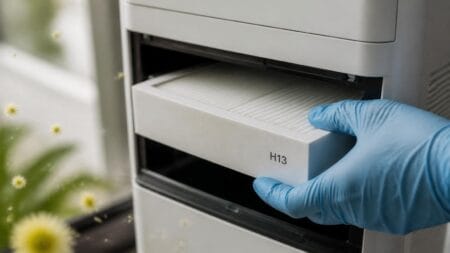
- Hybrid filtration with true HEPAModels combining ionisation with a certified true HEPA filter reduce airborne particles and limit reliance on ionisation alone, lowering surface deposition and ozone tradeoffs.Look forTrue HEPA rating (H13/H14) plus ioniser optionAvoidIonisation-only models without mechanical filtration
- Maintenance transparencyLook for clear filter lifetimes, accessible replacement parts, and simple cleaning instructions to ensure long‑term performance and avoid hidden risks from neglected units.Look forPublished filter lifetimes and replacement part availabilityAvoidObscure maintenance instructions or sealed units
Short Q&A: Common misconceptions
No — HEPA mechanically captures particles and provides more consistent removal.
Independent chamber and real‑room tests show HEPA yields predictable clean‑air delivery; ionisers often rely on charging and surface deposition, which varies with room conditions and measurement methods.
Not reliably — some lab studies report reductions, but real‑world inactivation is inconsistent.
Lab outcomes depend on microbe type, humidity and exposure time; comparisons with germicidal UV show UV effects are more reproducible ionisers compared with UV for microbes.
Some do, but many modern units emit ozone below regulatory limits — emissions vary widely by model.
Regulatory measurements and independent lab reports document a broad range of ozone outputs; only device‑specific test data show compliance with safety guidelines.
Not automatically — vulnerable occupants can be more sensitive to ozone or to particles resuspended from surfaces.
Public‑health summaries and independent tests advise verified low‑ozone devices and/or HEPA filtration for sleeping areas and those with respiratory conditions.
How to verify claims and measure real effects
Request specific third‑party data and use simple monitors to check a unit’s real‑world particle removal and ozone generation. Follow a brief spot‑test protocol that compares baseline and operating conditions.
- Ask for the right lab reports
Request independent test reports showing size‑resolved particle removal (PM1, PM2.5), CADR or equivalent, and ozone emissions measured under realistic room conditions. Prefer reports referencing recognized test methods or standards and conducted by an accredited lab.
- Choose practical monitors
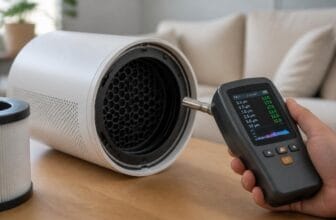
Use an optical particle counter (OPC) that reports particle counts or mass for PM1/PM2.5, plus an ozone monitor with ppb sensitivity (electrochemical or UV). Short‑term rental or university/community sensors can be used if purchase is impractical.
- Simple spot‑test protocol
Measure baseline for 10–15 minutes with closed doors/windows. Run the device at the intended setting and record particle and ozone readings every 5 minutes for 20–30 minutes. Repeat with room ventilation on; compare particle reduction and any ozone rise above baseline.
Minimum checks before trusting claims:
Confirm an independent lab name and test date are on reports. Look for particle removal by size (not only % vague claims). Ensure ozone stays near baseline (<50–100 ppb short‑term) in spot tests; any consistent rise warrants caution.If results are unclear, seek an independent indoor‑air lab or local university for more rigorous testing.
How to decide — run, test, or stop
- Prioritise independent, size‑resolved particle and ozone test reports from accredited labs.
- Use short spot checks with an ozone meter and particle counter to verify claims before regular use.
- Choose immediate cessation triggers: measured ozone rise, occupant irritation, visible deposits, or manufacturer recall.
Weigh evidence by source and measurement. Prefer independent, accredited lab reports and peer‑reviewed studies over manufacturer data; look for size‑resolved particle removal and explicit ozone measurements. Consumer‑group tests and national health agency guidance add useful context.
Act on clear stop signals. Stop operating the unit if short tests show an ozone rise above local background, if occupants experience irritation, if the unit is damaged or recalled, or if independent tests contradict manufacturer claims.
Unplug and stop use when:
An ozone meter shows a sustained increase over background while the unit runs. Any occupant reports respiratory irritation, coughing, or unusual smells. The unit is hot, sparking, or has visible surface residues. A credible recall or independent test flags safety or performance failures.