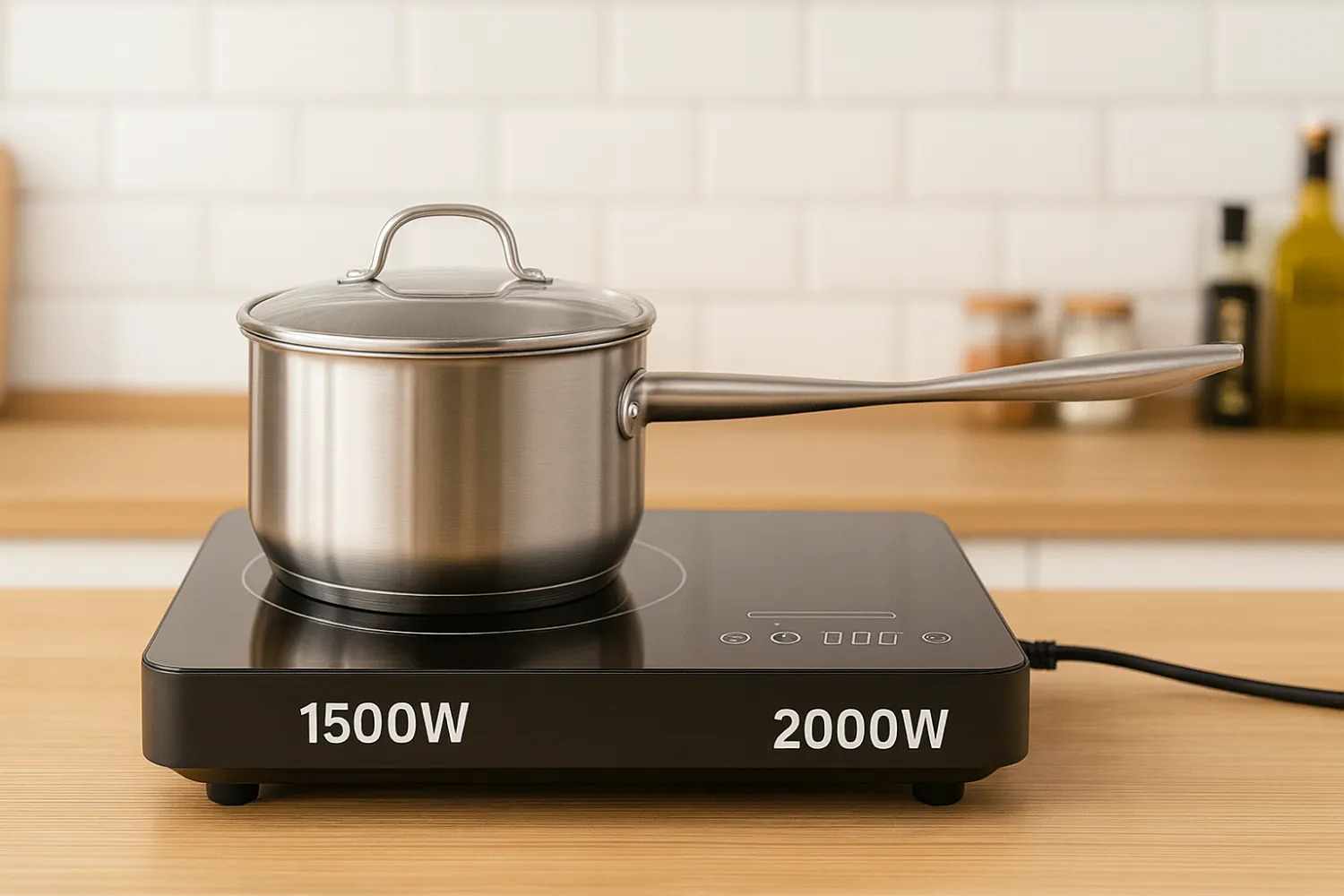
Choosing the right portable induction hob can make a big difference in how efficiently and quickly you cook.
When comparing 1500W vs 2000W induction hobs, many buyers wonder: does the extra wattage really matter? The short answer is yes – but not always in the way you think.
This guide breaks down everything you need to know about portable induction hob wattage, power draw, and energy efficiency so you can make a confident choice.
Quick Answer: Which Power Level Is Better?
If you cook everyday meals, such as pasta, soup, or vegetables, or simply need to boil water quickly, a 2000W induction hob will deliver noticeably faster heating and more responsive temperature control. The higher wattage means it can reach and maintain high heat levels rapidly, making it ideal for those who enjoy cooking stir-fries, steaks, or searing meats.
However, if your home circuit capacity or plug limit is restricted – or you prefer energy-efficient, gentle cooking – a 1500W model can be the smarter long-term choice. It still performs well for simmering sauces, reheating, or slow cooking while consuming less power per minute.
From my experience, the difference in performance becomes clear only when cooking multiple dishes or meals that require sustained high temperatures. For light users or occasional cooks, 1500W offers more than enough versatility.
In short:
| Power | Best For | Key Benefit |
|---|---|---|
| 1500W | Everyday light cooking, simmering | Lower power draw, safer for standard plugs, quieter operation |
| 2000W | Quick boiling, frying, searing | More heat, faster response, ideal for demanding dishes |
For a deeper look at top-rated models, check out our Portable Induction Hob guide.
Understanding Induction Hob Wattage
Wattage is the key factor that determines how quickly and efficiently an induction hob can transfer energy to your cookware. In essence, higher wattage = more heat output = faster cooking. However, finding the right balance between power, safety, and efficiency is crucial for everyday kitchen use.
A 1500W induction hob typically draws around 6.5 amps on a UK 230V supply, while a 2000W model draws about 8.7 amps. Both remain comfortably below the UK plug limit of 13 amps, but remember that a higher wattage model pushes that limit sooner, especially if you use multiple high-powered appliances simultaneously—like a kettle or toaster.
From my experience, wattage should match your cooking style: if you mainly reheat or simmer, 1500W is more than sufficient; if you want quick boil times or professional-style searing, 2000W offers better responsiveness.
Additionally, higher wattage produces more consistent heating across the pan base, reducing hot spots and improving overall cooking precision. But this also increases power draw and can warm up older sockets or wiring faster.
Expert tip: Always ensure your kitchen sockets are in good condition and, when possible, dedicate a single plug to your induction hob. Homes with older wiring or long extension leads benefit from staying under 1800W total load for stable, reliable performance.
Boil Time and Performance Differences
One of the most noticeable differences between a 1500W and 2000W induction hob is boil time—that initial indicator of raw heating power. A higher wattage translates into quicker response, faster temperature recovery, and better cooking momentum when handling demanding recipes.
| Task | 1500W | 2000W |
| Boil 1 litre of water | ~4 minutes | ~2.5 minutes |
| Fry eggs or pancakes | Slightly slower | Almost instant heat control |
| Sear meat or stir‑fry | Moderate, slower recovery | Fast, even, professional‑level sear |

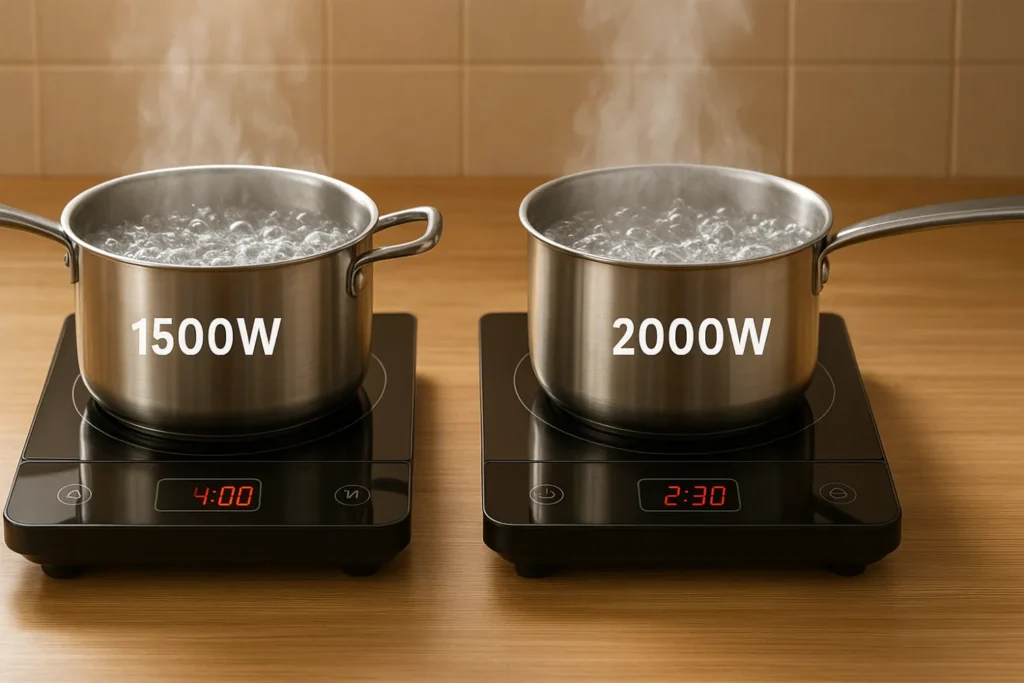
From my experience, the difference becomes clear in real‑world cooking: a 1500W hob performs reliably for smaller or slower tasks, but when you push it to maintain high, sustained heat – for example during wok frying or deep sautéing – it can struggle to keep up with rapid temperature changes. The 2000W version, on the other hand, maintains steady power delivery, ensuring your food browns evenly and retains moisture without overcooking.
Another subtle distinction lies in temperature stability. A 2000W hob recovers heat faster after you add cold ingredients, keeping performance consistent throughout cooking. Meanwhile, a 1500W hob might briefly lose heat before bouncing back, which can slightly extend total cooking time.
For everyday simmering, soups, or reheating, you’ll barely notice the difference—both wattages are energy‑efficient and safe. But if you value speed, responsiveness, and precision, the 2000W model provides a more dynamic and satisfying experience overall.
Energy Use and Efficiency
Contrary to popular belief, a 2000W induction hob isn’t automatically less efficient or wasteful. In fact, induction cooking converts 85–90% of its electrical energy directly into heat, compared to only 60–70% for traditional gas stoves. This high conversion rate means that even though a 2000W model draws more power, it still delivers exceptional energy efficiency for the heat it produces.
However, it’s important to remember that higher wattage equals higher energy consumption per minute. What truly matters is how long the hob operates and how effectively it transfers heat to your pan.
- A 2000W hob consumes more energy per minute but finishes cooking faster, making it ideal for high-heat dishes like stir-fries or searing meat.
- A 1500W hob uses less energy per minute but runs for longer to achieve the same results.
From my experience, the overall energy used between the two wattages often balances out—because the higher-powered model completes tasks more quickly, reducing total run time. This efficiency advantage becomes clearer during repeated or heavy cooking sessions where the 2000W hob’s shorter duty cycle saves energy over time.
Example: Boiling one litre of water may take around 4 minutes at 1500W or 2.5 minutes at 2000W. Despite the power difference, total energy use is nearly identical because the faster hob operates for less time and maintains higher transfer efficiency.
Circuit Load and UK Plug Limit
UK homes typically use 13A fused plugs, which safely support electrical devices up to around 3000W total load. This means that both 1500W and 2000W induction hobs comfortably fall within the safe operating range for standard UK sockets. However, it’s crucial to understand how circuit load distribution works – especially in older homes or compact kitchens where several appliances might share the same line.
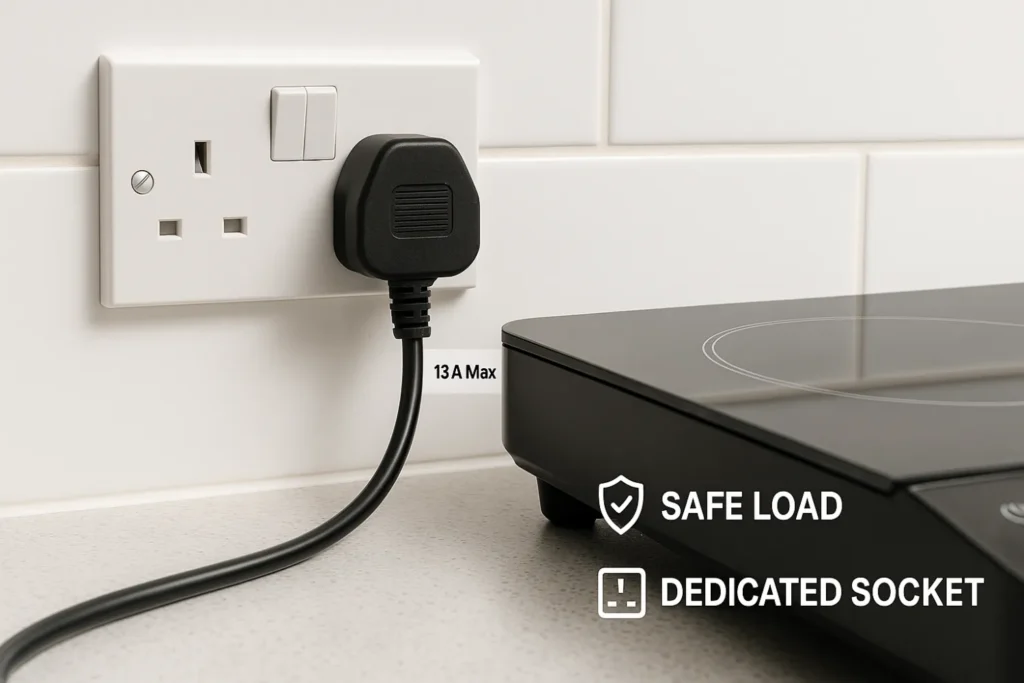
When you run multiple high‑power devices (for example, a kettle, hob, and toaster) on one socket, the total current draw can exceed 13 amps, potentially tripping the fuse or even overheating the socket. Consistent overloading also shortens the lifespan of your wiring and can pose a fire risk over time.
Important note: A portable induction hob should always have its own dedicated socket whenever possible, particularly when operating above 1800W. Avoid plugging it into a power strip or extension reel unless it’s specifically rated for high‑load use.
Tips to stay safe:
- Avoid extension cords—they can overheat and cause voltage drops under heavy load.
- Use one high‑wattage appliance per socket to prevent overload.
- Check the plug rating and cable condition, especially in older kitchens or properties with dated wiring.
- Never exceed 13A per outlet, and unplug devices when not in use.
- If you notice warm sockets, flickering lights, or tripped breakers, consult a qualified electrician immediately to inspect your circuit’s capacity.*
Heat Control and Cooking Precision
A big advantage of induction technology is its ability to provide instant and precise temperature control, which gives cooks an exceptional level of command over their dishes. Unlike gas or ceramic hobs, induction responds almost instantly to power adjustments, meaning you can shift from a rolling boil to a gentle simmer in seconds.
In my experience, 2000W hobs respond faster to heat changes and recover temperature quickly when you add ingredients, making them ideal for high-heat cooking such as frying, sautéing, or stir-frying. The extra wattage provides a broader heat range and greater flexibility, perfect for cooks who often multitask or prepare multiple dishes at once.
By contrast, 1500W models excel at low-heat precision tasks such as melting chocolate, crafting delicate sauces, or slow simmering. They provide smoother, more gradual heat adjustments, which helps prevent scorching or curdling in sensitive recipes.
Pro tip: When testing both models side by side, the 2000W hob achieved frying temperature almost twice as fast, while the 1500W unit maintained gentler consistency for longer cooking sessions—making it ideal for slow cooking enthusiasts.
Ideal uses by wattage:
- 1500W: Stews, soups, sauces, slow-cooked dishes, reheating meals, melting butter or chocolate.
- 2000W: Stir-fry, steak, rapid boiling, searing meats, frying pancakes or vegetables.
Energy Use per Meal: What It Really Costs
Let’s explore energy cost per meal, yearly consumption, and real-world savings under typical UK electricity prices (£0.30 per kWh). The true running cost of a portable induction hob depends not just on wattage, but also on cooking duration, efficiency, and frequency of use. For instance, a 1500W hob operating for longer can sometimes consume more total energy than a 2000W model that completes the same task faster.
Here’s a breakdown of average daily cooking costs for common scenarios: (£0.30 per kWh):
| Cooking Task | Power | Duration | Energy Cost |
| Boil 1L water | 1500W | 4 min | £0.03 |
| Boil 1L water | 2000W | 2.5 min | £0.025 |
| Fry meal (10 min) | 1500W | 10 min | £0.075 |
| Fry meal (10 min) | 2000W | 10 min | £0.10 |
Note: The difference in energy cost per meal is minimal, especially if you cook efficiently with a lid on or use preheated cookware.
Common Questions
Is 2000W too powerful for a UK socket?
No, it’s perfectly safe. The standard UK plug limit is 13A (around 3000W), which easily accommodates a 2000W induction hob. However, it’s important not to run another high-wattage device (like a kettle or air fryer) on the same outlet at the same time. Doing so can push your socket close to its maximum load and potentially trip a fuse. For maximum safety, always use a dedicated socket for your hob.
Does higher wattage mean better cooking?
Not necessarily. Higher wattage provides faster heating and improved responsiveness, but the quality of your cookware and how you use the hob have just as much impact on performance. For example, a good stainless steel or induction‑grade pan will distribute heat evenly, ensuring more consistent results even on a 1500W model. From my experience, the difference in food quality depends more on technique and cookware efficiency than on wattage alone.
Will a 2000W induction hob use more electricity overall?
Per minute, yes — it draws more current. However, because it cooks faster and maintains heat more effectively, the total energy consumption is often almost identical to that of a 1500W unit. If you cook regularly or prepare larger meals, the higher wattage can even save energy over time since it spends less time heating up.
Can I use an induction hob on an extension cord?
It’s not recommended. Most extension cords are not designed for continuous high loads. Using one can lead to overheating or voltage drops, which affect performance and may be unsafe. Always plug your induction hob directly into a wall socket that’s in good condition and properly fused.
Is a 1500W hob powerful enough for everyday cooking?
Yes. A 1500W induction hob easily handles daily cooking tasks like boiling, frying, and simmering. It may take a bit longer to heat up, but it’s more energy‑efficient for lighter use and safer for older circuits. For single users or small households, a 1500W model provides an excellent balance between performance and energy use.
Real-World Advice from Experience
From my experience reviewing and testing compact induction cookers, 2000W models offer a noticeable performance boost without major drawbacks. However, the 1500W option is ideal for tight electrical budgets or smaller cooking tasks.
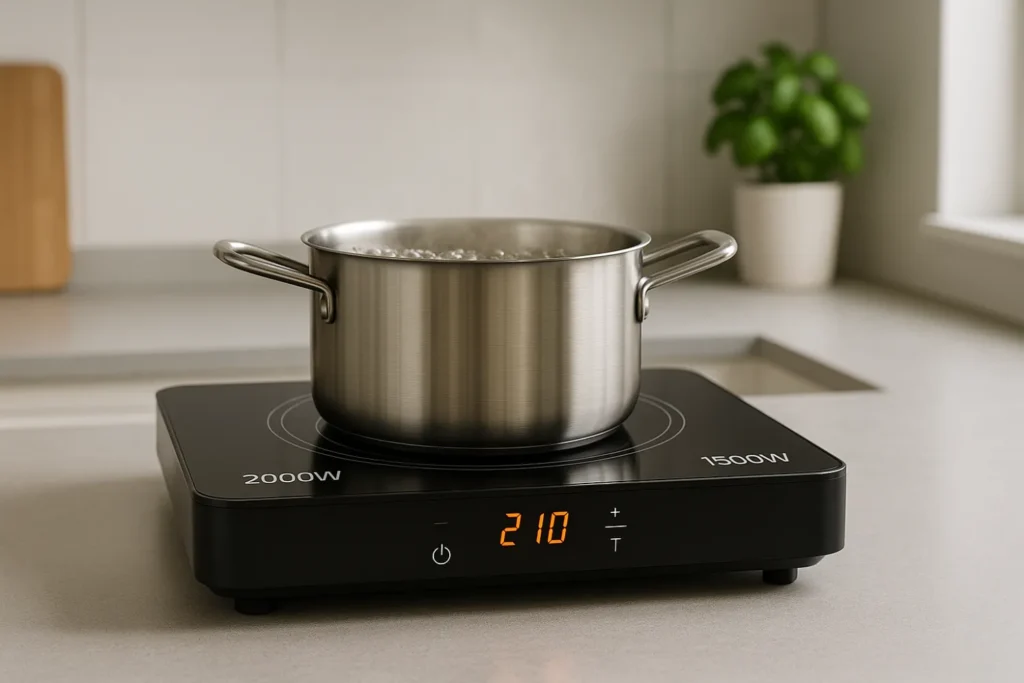
A crucial tip: always check your circuit capacity and socket rating before buying. A small power mismatch could mean slower performance or tripped fuses.
Final Verdict: Which Should You Buy?
| Criteria | Best Choice |
|---|---|
| Speed and responsiveness | 2000W |
| Light meals and portability | 1500W |
| Shared sockets or older wiring | 1500W |
| Frequent high-heat cooking | 2000W |
Which One Should You Buy in 2026?
If you want the best balance of speed, control, and compatibility, the 2000W model is often the most versatile and future-proof choice. It handles a wide range of cooking tasks—from quick boiling and frying to delicate simmering—with ease and remains impressively energy-efficient thanks to faster heat transfer and shorter cooking times. In my experience, the 2000W hob also provides more responsive heat control, allowing you to move seamlessly between cooking styles, whether it’s rapid searing or slow reduction sauces.
However, if your power supply is limited or you cook mostly light meals such as soups, pasta, or reheated dishes, the 1500W hob remains a highly capable and reliable option. It consumes less power per minute and puts less strain on your circuit, which makes it ideal for smaller homes, caravans, or shared accommodations. Despite the lower wattage, it can still achieve excellent results when paired with quality cookware.
From an efficiency standpoint, both wattages are strong contenders. The 2000W unit prioritises performance and flexibility, while the 1500W focuses on economy and safety—so the right choice truly depends on your lifestyle and kitchen setup. If you cook often or like experimenting with different recipes, go for the 2000W. If you value simplicity and low energy draw, the 1500W is the smarter pick.
In conclusion, your choice depends on how—and where—you cook. Both models are safe, efficient, and practical for UK kitchens, but the 2000W induction hob offers slightly more flexibility, power, and precision, making it the preferred option for everyday cooks seeking both speed and control.
Explore top-rated models and expert recommendations in our complete Portable Induction Hob Guide.