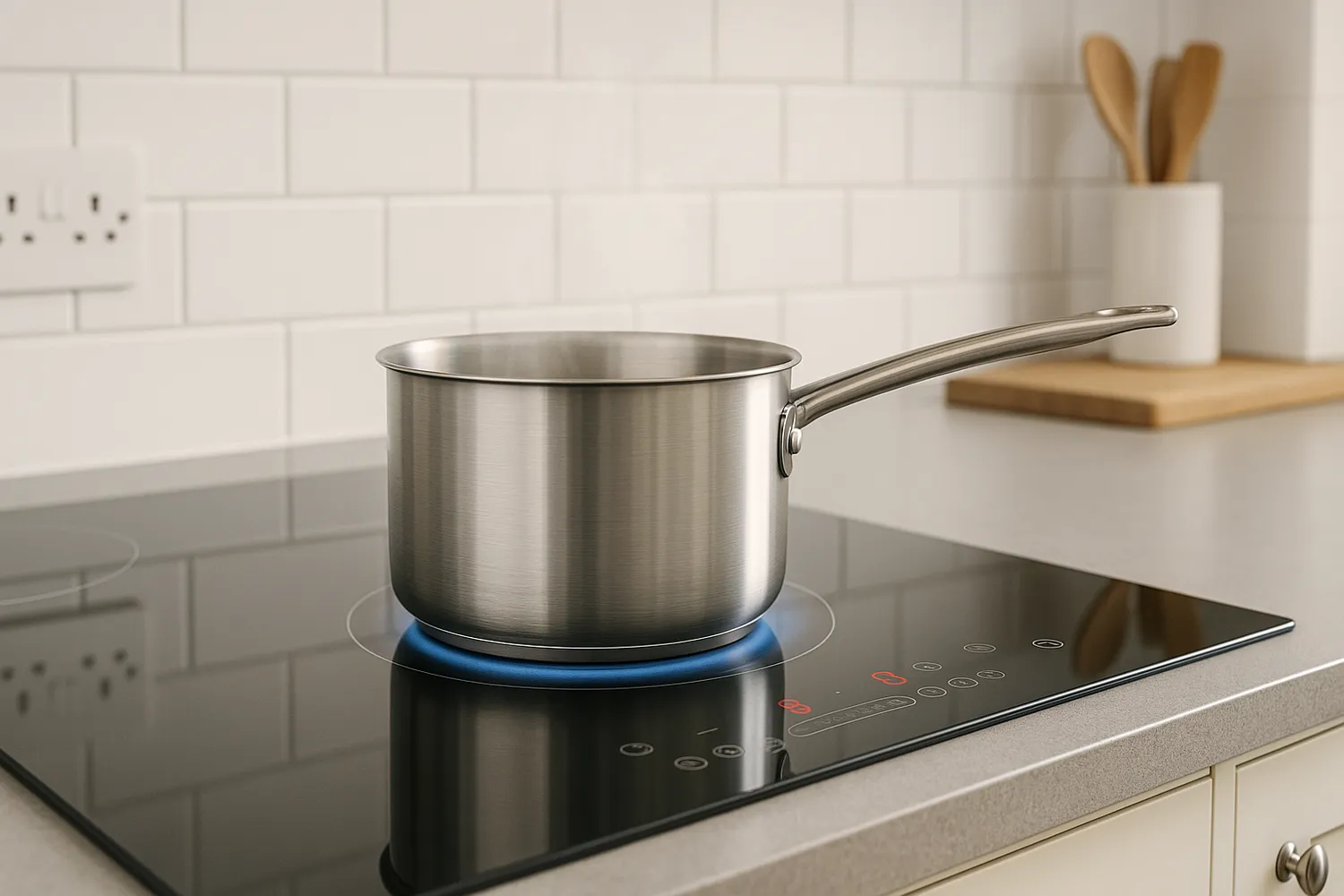
Upgrading to an induction hob can make cooking a lot faster and more efficient. Not every pot or pan will work, though, you will need induction-ready cookware.
To check if your cookware is induction-ready, place a magnet on the bottom – if it sticks firmly, your pan is compatible. This quick test really saves you time and keeps things simple when moving to induction cooking.
Induction cooking uses magnetic energy to heat your cookware directly, not the hob’s surface. Only pans made with ferromagnetic materials—like cast iron or certain stainless steels—will actually work.
Aluminium, copper, and glass pans usually don’t unless they have a magnetic base. It’s a bit of a bummer if you love your old pans, but that’s just how it is.
Key Takeaways:
- Induction cooking needs cookware made from magnetic materials.
- A magnet test quickly shows if your pan will work on an induction hob.
- Flat, thick bases improve heat transfer and cooking performance.
Recommended Products for Induction Cooking
Induction pots and pans sets are an easy way to ensure full compatibility with your induction hob while upgrading your kitchen with durable, efficient cookware.
These sets typically include a mix of saucepans, frying pans and larger pots, all designed with a magnetic base for fast, even heating.
They’re ideal for anyone who wants a reliable, matching collection that works flawlessly on modern induction cooktops.
-

- 8-PIECE SET: Our marble cookware set includes 24cm casserole pot with lid, 16cm and 18cm saucepan with lid, 20cm and 24cm frying pan.
- QUALITY MATERIAL: The Nuovva induction pot and pan set features a premium quality marble coating, a safer and stronger alternative to other chemical non-stick cookware.
- NON-STICK: The marble 8pcs kitchen set features a non stick quality allowing much easier maintenance, less force and chemicals needed to clean!
- HEALTHY: Our kitchen cookware set is a safer alternative to traditional non stick coatings made from toxic chemicals and minimise the use of oil needed to cook, make a difference to your health and cooking!
- KITCHEN ESSENTIAL: Prepare an assortment of dishes with our marble cookware pots and pans set with lids; stir fry, stew, sear, boil, simmer, and so much more! A great gift for a loved one for all occasions!
-

- DURABLE TITANIUM NON-STICK COATING: Titanium Non-Stick Coating: Non-Stick Surface reinforced with Titanium particles to provide durable non-stick cooking performance.
- THERMO-SIGNAL HEAT INDICATOR: Innovative heat indicator turns solid red when the pan reaches the ideal temperature, helping you cook with precision and confidence.
- SUITABLE FOR ALL HOBS INCLUDING INDUCTION: Engineered for complete hob compatibility – works on gas, electric, ceramic, halogen and induction cookers.
- EASY TO CLEAN: Titanium non-stick coating ensures food slides off effortlessly minimising the need for scrubbing and making washing up quick and easy.
- 100% SAFE NON-STICK COATING: no PFOA, no Lead, no Cadmium. (Stricter controls than those required by current food contact regulations for each new range. No lead no cadmium (no Pb no Cd) means no intentional addition of Pb and Cd in the coatings. No migration above detection threshold).
- COMPLETE 5-PIECE SET FOR EVERYDAY USE: Includes 16 cm, 18 cm and 20 cm saucepans with lids, plus 22 cm and 26 cm frying pans – perfect for daily family meals and versatile cooking.
-

- Basic 7-Piece Kitchen Cookware Set: 16cm Sauce Pan w/Lid, 20cm Soup Pot w/Lid, 24cm Frying Pan w/Lid, 20 cm Frying Pan without Lid, the lid is made of tempered glass and has a vent
- Cooking Healthy & Safe: Coated with nonstick black granite coating ensures ultra-durable performance and unparalleled food release, ideal for healthy, low-fat cooking with easy cleanup. Produces zero hazardous waste, free of PFOA, PFAS, lead and cadmium
- Attractive & Durable: Each piece is expertly crafted with premium-grade stainless steel for top-notch heat conductivity and distribution. Finished with a glossy granite coating on the interiors and exteriors, these pots and pans are engineered for exceptional durability, ensuring they maintain their sleek appearance even with daily use
- Transparent Glass Lids: Tempered glass lids with good sealing and lock in flavor, texture, and nutrients while clear lids provide an easy way to view culinary masterpieces as they cook to perfection. Each lid has a vent to avoid burns to the hands from hot water vapour when the lid is opened
- All Stovetops Compatible: Tri-ply stainless-steel construction ensures fast, even heating and universal compatibility with all stovetops—including induction, gas, electric, ceramic, and glass. Oven-safe up to 450°F, so you can easily go from stovetop to oven for versatile cooking
- Best Service: We are here to offer you only the best quality products designed to make your life easier. If you need any help, please feel free to contact us via Amazon, our 24/7 live customer support is ready and waiting to assist with anything you need
-
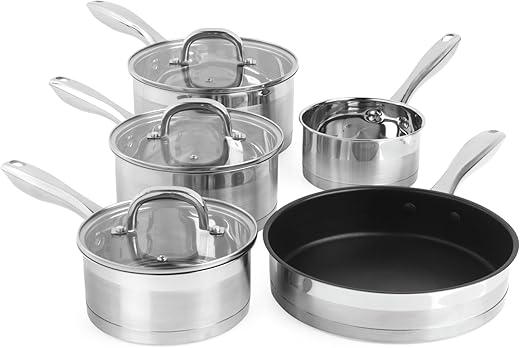
- 5 PIECE PAN SET: Perfect for all your cooking needs! This Salter Timeless pan set includes 16, 18 and 20 cm saucepans, a 14 cm milk pan and a 24 cm non-stick frying pan so you can explore a variety of recipes.
- SUITABLE FOR ALL HOB TYPES: Designed for every home – this versatile pan set is suitable for use on all hobs including gas, electric, halogen, radiant ring, and induction.
- STAINLESS STEEL: Cook with confidence! Each pan is made from high quality stainless steel meaning it will maintain its extreme durability, even with regular use and is dishwasher safe for easy cleaning.
- TEMPERED GLASS LIDS: The saucepans are equipped with tempered glass lids with steam vents, so you can lock in nutrients and monitor your cooking progress without releasing heat.
- EVEN HEAT DISTRIBUTION: Cook your food to perfection every time using this Salter pan set. The durable base retains heat well and offers even heat distribution.
-

- 17-Piece Cookware Set Includes – 2QT Sauce Pan, 3QT Sauce Pan, 20cm Frying Pan, 24cm Frying Pan, 24cm Saute Pan (4QT), Removable Handle*2, 18cm Glass Lid, 20cm Glass Lid, 24cm Glass Lid, Pot Protector*5, Fridge Storage Lid*2
- SAVE MORE SPACE – This pots and pans set is stackable with removable handles, saving up to 75% space for easy storage in a cabinet or RV.
- Sturdy and durable removable handle – holds up to 22 lbs, perfect for pots and pans with removable handles, no need to worry about the handle wobbling, more convenient to use and effective against burns
- Suitable for all types of stoves – Our cookware set is suitable for all types of stoves, including gas, electric and induction. The padded bottom heats up quickly and evenly, so whether you’re preparing a quick meal or hosting a dinner party, the set’s excellent heat distribution ensures even results every time you cook.
- MULTI-PURPOSE COOKER – Meet your different cooking needs, the removable handles provide good flexibility, allowing you to easily move the cookware from the oven to the table and from the refrigerator to the stovetop.


Understanding Induction Cooking and Compatibility
Induction cooking uses magnetic energy to heat cookware directly. This means faster, more efficient cooking.
You’ll need cookware that can interact with the cooktop’s magnetic field and spread heat evenly. Otherwise, you’re just wasting energy.


How Induction Cooktops Work
An induction cooktop creates heat through an electromagnetic field instead of an open flame or electric coil. Under the glass surface, a copper coil makes a magnetic field when powered up.
Set a pan with a ferromagnetic base—like cast iron or magnetic stainless steel—on the cooktop, and the magnetic field stirs up tiny electrical currents in the metal. That’s what actually heats your food.
The cooktop itself stays pretty cool, so you waste less energy and it’s safer. Heat stops the second you lift the pan, so you get really precise control.
Want to check if a pan will work? Just hold a magnet to the bottom. If it sticks well, you’re good to go.
Why Cookware Compatibility Matters
Only cookware that reacts to a magnetic field can heat on an induction cooktop. No magnetic base, no heat—your food stays cold.
Materials like cast iron, carbon steel, and magnetic stainless steel work best because they’ve got plenty of iron. They heat evenly and help avoid annoying hot spots.
Aluminium, copper, and glass pans won’t work unless there’s a bonded magnetic layer at the base. Always check for the induction symbol—it’s usually a coil mark—on the packaging or the cookware.
Thicker magnetic layers are better. They help with heat transfer and keep pans from warping at high temps.
Benefits of Induction Cooking
Induction cooking is efficient and gives you a lot of control. Since heat forms directly in the pan, you lose very little energy, and cooking goes faster than with gas or electric stoves.
The cooktop surface stays cool, which means fewer burns and easier cleanup—spills don’t bake on. That’s a relief, honestly.
You get super precise temperature control, so you can simmer sauces or boil water in no time. Even heat distribution means better results and tastier food.
Induction is quiet, quick to respond, and pretty energy-efficient. It’s a solid choice if you’re updating your kitchen.
The Magnet Test: The Quickest Way to Check Cookware
The easiest way to check if your pan is induction ready? Try the magnet test. Just grab a magnet and see if it sticks to the bottom—no fancy tools needed.
This helps you confirm if your cookware has a magnetic base made from ferromagnetic materials. It’s quick and straightforward.
Step-by-Step Guide to the Magnet Test
- Find a magnet. A fridge magnet works fine, but a stronger one is even better.
- Clean the pan’s base. Make sure it’s dry and not greasy.
- Place the magnet on the bottom. Hold it flat against the centre.
- Check the pull. See if it sticks firmly, weakly, or not at all.
If the magnet sticks firmly, your pan is induction compatible. A weak pull means it might work, but you could get uneven heating. If it doesn’t stick, the pan won’t work on induction—simple as that.
You can also look for an induction symbol (usually a coil shape) on the pan or its packaging. That’s a good sign it’s made for induction.
What Magnetism Reveals About Your Cookware
Induction cooktops heat with electromagnetic fields that react only with ferromagnetic cookware. If your magnet sticks, the pan’s base has iron or a magnetic stainless steel alloy.
Cookware made from cast iron, carbon steel, or magnetic stainless steel usually passes. Pans made from aluminium, copper, or glass won’t, unless there’s a magnetic base layer added.
The magnet test is a quick way to spot this—no need to get technical. If it sticks, you’re set for induction cooking.
Limitations of the Magnet Test
The magnet test is pretty reliable, but not perfect. Some multi-layered pans have just a thin magnetic layer—so a magnet will stick, but the pan might not heat well or evenly.
Even a strong pull doesn’t guarantee great heat distribution or efficiency. Cheap pans can still heat unevenly.
Some enameled cast iron or clad stainless steel pans act differently depending on how thick the magnetic base is. If you’re unsure, check with the manufacturer or look for clear product labels along with doing the magnet test.
Cookware Materials and Their Induction Suitability
Different cookware materials react to induction heat in their own ways. The type of metal and how magnetic it is will decide if your pan works well—or at all—on induction.
Knowing this makes it easier to pick cookware that heats evenly, saves energy, and just works when you need it.

Stainless Steel and Its Variations
Stainless steel is a favorite for its durability and sleek look. But not all stainless steel is induction-compatible.
Only grades with enough iron, like 18/0 stainless steel, will attract a magnet and work on induction. Many top brands, like All-Clad, use layers of stainless steel with an aluminium or copper core. The outside layer needs to be magnetic for induction to work.
If a magnet sticks well to the base, you’re set. Multi-ply stainless steel pans heat evenly and don’t warp easily. They’re also easy to clean and don’t react with food. Always check the label or do the magnet test.
Cast Iron and Enameled Cast Iron
Cast iron cookware is naturally magnetic and works perfectly on induction cooktops. It holds heat for ages, so it’s great for slow cooking and searing.
Both bare and enameled cast iron pans work on induction. The enamel doesn’t mess with magnetism—it just protects the pan from rust and makes upkeep easier. Brands like Le Creuset and Staub are classics here.
Cast iron is heavy, though, so be careful not to scratch your induction hob. A flat, smooth base helps with even heating.
Aluminium and Copper Cookware
Aluminium and copper cookware aren’t magnetic, so they don’t work on induction unless they’ve got a special base. Lots of modern pans add a ferromagnetic base (basically, a layer of magnetic stainless steel) to fix this.
This way, aluminium and copper pans can heat on induction and still give you that fast, even heating they’re known for. Look for the induction symbol or use a magnet to be sure before buying.
If there’s no magnetic base, these pans won’t work. Induction-adapted versions are out there, and they’re worth it if you love your copper or aluminium pans.
Ceramic and Other Non-Magnetic Materials
Ceramic, glass, and stoneware cookware don’t have iron, so they’re not magnetic. They just won’t work on induction cooktops.
Some ceramic-coated pans are built on a magnetic stainless steel or iron base, though. Those are fine for induction—the magnetic layer is what matters.
Always check for the induction symbol (a coil icon) or use a magnet. Pure ceramic or glass is better for ovens or regular electric hobs, not for induction.
Other Key Signs of Induction-Ready Cookware
You can check if your cookware is induction ready by looking for certain markings, reading what the manufacturer says, or just testing it on an induction hob. Each way helps you make sure your pans are made with the right stuff for induction.
Induction Symbol Identification
Most induction-ready cookware has an induction symbol stamped on the base or packaging. It usually looks like a small coil or a few loops, sometimes with the word induction nearby.
If you spot this symbol, it means the cookware has a ferromagnetic base that’ll work with induction. If it’s missing, don’t assume—it’s worth checking further.
Some brands emboss the symbol right into the metal; others just print it on the label. Check both before you buy or use new pans.
| Symbol | Meaning |
|---|---|
| Coil or loop pattern | Induction compatible |
| No symbol | Check further before use |
Manufacturer Labelling and Guidelines
Manufacturers usually mark their products as “induction ready” or “induction compatible” on the box or in the product description.
Sometimes you’ll spot this info hiding in the care guide or technical specs too.
Labels often list which cooktops the pan suits—gas, electric, ceramic, and induction.
If you see “induction” mentioned, it means there’s a magnetic layer or base built in for that purpose.
If you’re not sure, just check the manufacturer’s website or give their customer service a ring.
Most solid brands are pretty good about sharing details on the cookware’s materials and what it works with.
Don’t just guess based on how a pan looks or feels—stick to official info.
Testing on an Induction Hob
If you can’t find clear markings, you can always do a quick test yourself.
Add a splash of water to the pan, set it on the induction hob, and turn it on low.
If the water heats up fast and evenly, your pan’s probably induction compatible.
If it stays cold or heats weirdly, it’s likely missing that magnetic base.
There’s also the classic magnet test: just stick a magnet to the bottom.
If it grabs on tight, you’re good to go—no need to fire up the stove.

Base Design: Thickness and Flatness for Optimal Performance
The way your cookware’s base is built really shapes how it heats up on an induction hob.
A base that’s both thick and flat means better contact, more efficient energy transfer, and more predictable results.
Importance of Base Thickness
Base thickness affects how heat spreads across the pan.
Thicker bases store and spread heat more evenly, so you get fewer burnt spots.
Thin bases heat up fast but lose heat just as quickly, and that can mean uneven cooking.
For induction, a medium to heavy-gauge base—usually 3 to 5 mm thick—hits the sweet spot between quick response and steady heat.
It helps keep things stable if you toss in cold ingredients or change the temp suddenly.
Thicker bases also fight off warping over time, which is important because warping messes with the contact between pan and hob.
Check thickness by looking at product specs or just by feeling the weight—heavier pans tend to have thicker, tougher bases.
| Base Type | Typical Thickness | Performance |
|---|---|---|
| Thin (<3 mm) | Heats quickly, uneven heat distribution | Moderate |
| Medium (3–5 mm) | Even heating, good control | Ideal |
| Thick (>5 mm) | Slow to heat, retains heat well | Best for long cooking |
Why a Flat Base Matters for Induction
A flat base is key for solid contact with your induction hob’s glass surface.
Induction works by magnetic fields, so any gap—no matter how tiny—weakens the connection.
Even little curves or bumps can mess with heat transfer.
When the base is flat, the magnetic field hits the whole surface, giving you uniform heating and quicker results.
If the base’s warped, your hob might sense poor contact and cut the power automatically.
To check for flatness, set the pan on a smooth countertop and see if it wobbles or spins.
If it does, it might not work as well on induction and could even scratch the glass.
How Base Design Affects Heating Efficiency
The base design really does shape how efficiently energy moves from hob to food.
Induction cooktops use magnetic fields to make heat right inside the pan.
A base that’s flat, thick, and ferromagnetic keeps energy transfer steady and controlled.
If the base is too thin or uneven, you’ll notice patchy heat—sometimes the centre cooks faster than the edges.
Well-designed bases spread heat evenly, so you don’t have to stir as much or worry about food cooking at different rates.
Some pans use multi-layered bases—think stainless steel with an aluminium or copper layer sandwiched in.
This combo spreads heat better but still works with induction, so you get even temps, which is handy for simmering or making delicate sauces.
Expert Tips for Choosing and Caring for Induction Cookware
Picking induction-ready cookware means checking materials, base design, and build quality.
If you use and care for it right, you’ll keep it working well for years.
Selecting the Best Induction-Ready Cookware
Go for cookware with a magnetic base—things like stainless steel or cast iron are great.
These metals let the induction cooktop do its thing efficiently.
Try the magnet test: stick a magnet underneath—if it clings, you’re set.
Look for a flat, thick base too.
Flat bottoms mean better contact, and a thick base helps heat distribute evenly and resist warping.
Skip pans with rounded or uneven bottoms.
Watch for the induction symbol (it looks like a coil) on the box or pan base.
With sets, double-check that every piece is marked induction-safe—sometimes mixed sets sneak in non-compatible stuff.
Recommended materials:
| Material | Induction Compatibility | Notes |
|---|---|---|
| Cast Iron | Excellent | Heavy, retains heat well |
| Stainless Steel (magnetic grade) | Good | Durable and easy to clean |
| Aluminium with induction base | Fair | Works only with magnetic layer |
| Copper with induction base | Fair | Heats evenly but may cost more |
Avoiding Common Pitfalls
Don’t assume all stainless steel pans work on induction—some grades, like 18/10, aren’t magnetic.
Always do the magnet test or check the label to be sure.
Steer clear of lightweight or thin pans.
They can heat unevenly and are more likely to warp, which messes with efficiency.
Be picky with non-stick cookware—only use ones that say “induction-compatible.”
Some coatings can break down at high heat, and dragging pans across the glass can scratch it, so always lift instead of sliding.
If you’re using pans with layered bases, make sure the magnetic layer’s still intact.
If that layer gets damaged, the pan won’t work on induction anymore.
Care and Maintenance Advice
Wash induction pans with a soft sponge and mild detergent.
Skip abrasive pads—they’ll scratch the base or ruin non-stick coatings.
Dry thoroughly, especially with cast iron, to keep rust away.
When stacking, put protective pads or cloth between pans to dodge scratches.
Keep the base clean and smooth—any gunk can mess with the magnetic connection.
For cast iron, season it now and then to keep its non-stick quality and stop rust.
Stainless steel likes a gentle polish to stay shiny.
Let cookware cool before washing—sudden temperature swings can warp or damage the base.
Frequently Asked Questions
Induction cooking depends on magnetic interaction between the hob and the pan’s base.
You can spot the right cookware with a couple of easy tests, material checks, or by looking for certain labels and designs.
What methods can be used to determine if cookware is suitable for induction hobs?
Try the magnet test: stick a magnet on the bottom of the pan.
If it holds tight, odds are it’s induction-friendly.
Or do the water test: add water, set the pan on the hob, and turn it on.
If the water heats up fast and evenly, it’s a match.
Are there specific materials that are inherently compatible with induction cooking surfaces?
Cookware made from ferromagnetic materials is best—think cast iron, carbon steel, and many types of stainless steel that have iron in them.
Materials like copper, aluminium, and glass aren’t naturally magnetic, unless there’s a magnetic layer added to the base.
How does the presence of a magnetic base in cookware influence its induction readiness?
An induction hob uses a magnetic field to make heat directly in the pan.
If the base is magnetic, the field creates electric currents and heats the metal up.
No magnetic base? The hob just can’t transfer energy, so the pan won’t heat.
Can induction compatibility be affected by the shape or size of the cookware?
Absolutely. The bottom has to be flat for good contact with the hob.
Curved or uneven bases mean less efficiency and patchy heating.
The size matters too—the pan should cover the induction coil area.
If it’s too small, the hob might not even sense it, or you’ll get uneven heating.
What are the visual indicators that signify cookware is induction-capable?
Look for the induction symbol—usually a coil or some loops—on the pan or packaging.
Some pans are marked as “induction-ready” or “suitable for induction cooking.”
If you see those, the manufacturer made it for induction hobs.
Is it possible to use non-induction cookware on induction hobs with any special accessories?
You can grab a converter disc or an induction interface plate. This little gadget sits between your hob and any non-magnetic pan, letting the heat move from the induction surface to your cookware.
Just a heads up—this workaround isn’t super efficient and tends to slow down your cooking. It’s really only worth trying if you don’t have induction-friendly pans on hand.